
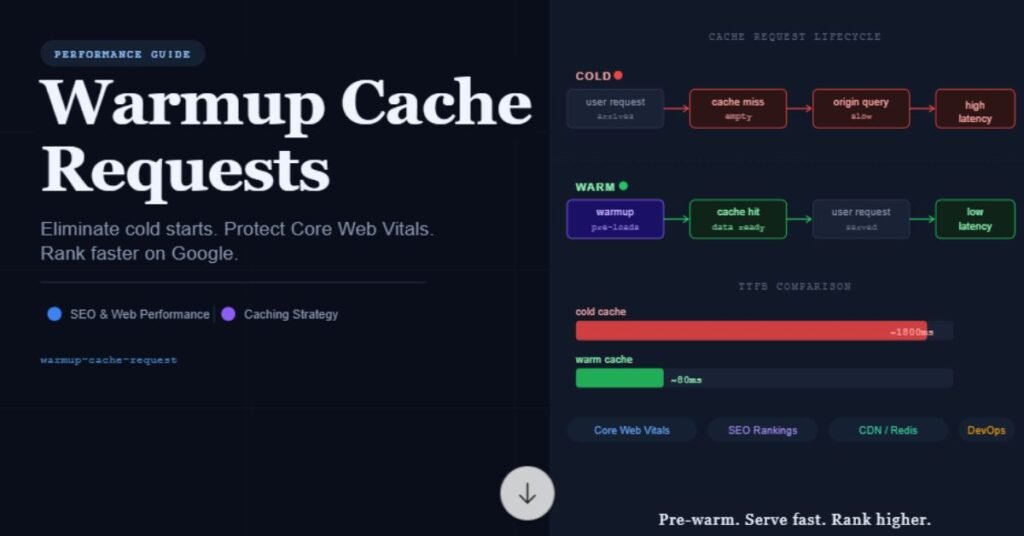
If you’ve ever noticed a website loading slowly right after a deployment or restart, you’ve experienced a cold cache in action. A warmup cache request is the technique used to prevent exactly that — by proactively filling the cache before real users ever hit your server.
In a performance-first web environment where Google’s Core Web Vitals directly influence rankings, understanding cache warmup isn’t just a developer concern. It’s an SEO and user experience priority.
What Is a Warmup Cache Request?
A warmup cache request is a pre-emptive request made to a server or application to load and store data in the cache before users arrive. Instead of waiting for the first real user to trigger a slow database query or expensive computation, you send synthetic requests ahead of time to “warm” the cache.
The result: when real users land on your site, data is already cached and ready to serve instantly.
Think of it like preheating an oven before you bake. The food (your response) cooks much faster when the environment is already at temperature.
Why Cache Warmup Matters for Performance and SEO
Cold caches hurt real users — and search rankings
When a cache is empty (cold), every incoming request has to go all the way to the origin server, execute database queries, render templates, and return a full response. This is slow — sometimes dramatically so.
For sites using tools like Varnish, Redis, Memcached, CDNs, or application-level caching, the first request after a restart or deployment can be 5–20x slower than a cached response.
This matters for SEO because:
- Google measures page speed as part of its Core Web Vitals (LCP, FID/INP, CLS). A slow first response degrades these signals.
- Googlebot crawls your pages — and if it hits a cold cache during crawl, it may record a slow TTFB (Time to First Byte), which influences crawl budget and perceived site quality.
- Real user metrics (via Chrome User Experience Report) feed directly into Google’s ranking signals.
A warm cache keeps all of these metrics healthy.
How Cache Warmup Works
The core process is straightforward:
- An application restart, new deployment, or cache flush empties the cache.
- Before real users arrive, a warmup process sends HTTP requests to key URLs or endpoints.
- The server processes these requests as normal, generating responses.
- Those responses get stored in the cache.
- When real users arrive, they receive cached responses immediately.
The warmup requests can be triggered in several ways:
- Scheduled scripts that run immediately post-deployment
- CI/CD pipeline hooks that execute cache priming as part of the release process
- Sitemap crawlers that systematically visit all important URLs
- Application startup events that trigger internal pre-loading logic
Types of Cache Warmup Strategies
1. URL-based warmup (most common)
This involves fetching a list of high-priority URLs — typically pulled from a sitemap or analytics data — using tools like curl, wget, or custom scripts.
bash
while read url; do curl -s -o /dev/null "$url"; done < urls.txtThis simple approach works well for content-heavy sites, e-commerce product pages, or blog archives where you know which pages get the most traffic.
2. Application-level warmup
Some frameworks and caching layers (like Spring Boot, Laravel, or Symfony) offer built-in warmup hooks. You can register warmup logic that runs on startup to pre-populate object caches, query caches, or session stores before the application accepts traffic.
3. CDN cache warmup
For globally distributed content delivery networks (like Cloudflare, Fastly, or AWS CloudFront), warmup involves pushing requests through edge nodes so that content is cached at the network edge closest to your users. This is especially important after a cache purge or a new content deployment.
4. Database query warmup
Some applications cache the results of expensive database queries. Warming these caches means executing the most common queries right after startup so the results are stored before users trigger them organically.
When Should You Warm Your Cache?
Cache warmup is most valuable in these situations:
- After a deployment or server restart — caches are cleared and need to be refilled
- After a cache flush — intentionally clearing stale content also clears valid content
- Before a traffic spike — if you’re anticipating a product launch, a TV ad airing, or a marketing campaign, pre-warming ensures performance holds under load
- After CDN cache expiry — TTL (time-to-live) settings mean cache entries expire regularly; warmup scripts can refresh them proactively
Practical Tips for Effective Cache Warmup
Prioritize by traffic value. Don’t try to warm every URL on a large site. Use analytics to identify the top 100–500 pages and focus there first.
Respect rate limits. If your warmup script fires too aggressively, it can overload your own server. Add delays between requests (sleep 0.5 in a shell script, for example) or use concurrency limits.
Warm in the right order. Start with pages that have the most downstream dependencies — homepages, category pages, and navigation elements that appear across many pages.
Automate it in your deployment pipeline. The best warmup processes are invisible and automatic. Integrate cache warming into your CI/CD process so it happens every time you deploy.
Monitor TTFB before and after. Use tools like Google Search Console, WebPageTest, or your own monitoring stack to track Time to First Byte. This is the most direct signal that your warmup is working.
Use realistic headers. When sending warmup requests, include Accept-Encoding, User-Agent, and other headers that mirror real browser behavior. Some caching layers generate different cached responses based on headers.
Cache Warmup vs. Cache Priming vs. Cache Preloading
These terms are often used interchangeably, but there are subtle distinctions:
- Cache warmup typically refers to the process of filling an empty or cold cache before it’s needed
- Cache priming is similar but sometimes refers specifically to seeding a cache with known values (e.g., from a database export)
- Cache preloading often implies a more deliberate, structured approach — loading specific data sets or assets in advance of a predictable event
For practical purposes, these concepts overlap significantly. The underlying goal is the same: ensure the cache is populated before demand arrives.
Common Mistakes to Avoid
Warming too infrequently. If your TTL is set to 1 hour, you need to re-warm at least that often for pages that receive consistent traffic.
Ignoring device or user-agent variants. Some caching setups serve different content to mobile vs. desktop users. Make sure your warmup covers both variants.
Forgetting authenticated vs. public pages. Warmup scripts typically only work for public, unauthenticated pages. Personalized or session-dependent content usually can’t be pre-cached this way.
Not measuring impact. Cache warmup is useless if you don’t confirm it’s working. Always verify with monitoring tools that cache hit rates improve after your warmup runs.
Conclusion
A warmup cache request is one of the simplest and highest-impact performance techniques available to web developers and site owners. By proactively filling your cache before users arrive, you eliminate the cold-start penalty that degrades both user experience and search rankings.
For SEO in particular, a consistently warm cache directly supports faster TTFB, better Core Web Vitals scores, and more efficient Googlebot crawling — all factors that contribute to how your site performs in search.
Whether you’re running a high-traffic e-commerce store, a content-heavy blog, or an API-driven application, building cache warmup into your deployment process is a practice worth adopting. It’s low effort, high reward, and something Google’s crawlers will quietly thank you for.

George is a digital growth strategist and the driving force behind Business Ranker, a platform dedicated to helping businesses improve their online visibility and search engine rankings. With a strong understanding of SEO, content strategy, and data-driven marketing, George works closely with brands to turn traffic into real, measurable growth.