
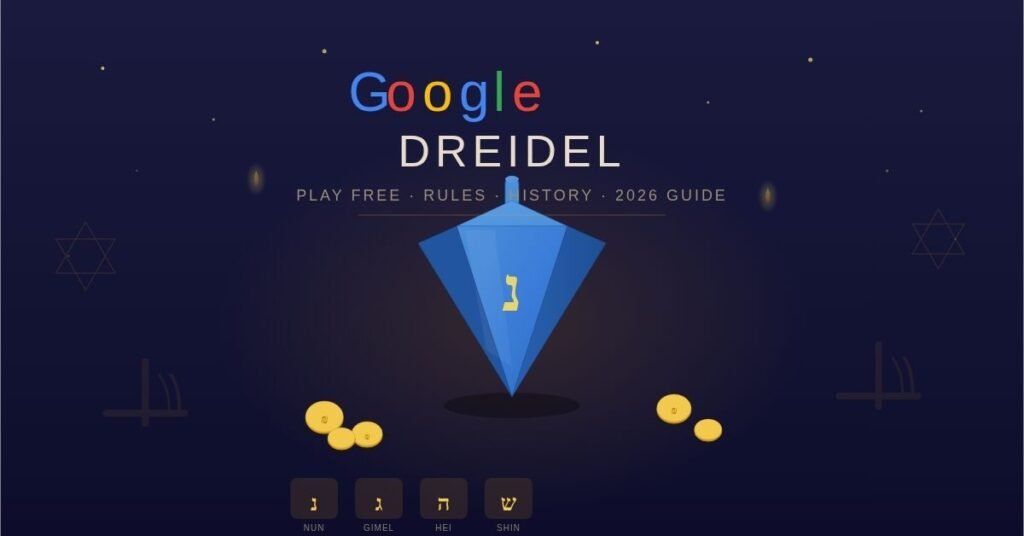
You typed “dreidel” into Google and a little spinning top appeared on your screen. Or maybe you heard about it and it didn’t show up at all. Either way, you’re here because you want to know what Google Dreidel actually is, how to play it properly, and — let’s be honest — whether you can still access it right now.
Google Dreidel is one of Google’s best interactive Easter eggs: a free, browser-based version of the classic Hanukkah spinning top game that has shown up in Google Search results every holiday season since 2011. It’s charming, it’s instant, and it carries more cultural weight than most people realize.
This guide covers everything — how to find and launch the game, what the four Hebrew letters mean, the full rules for playing with friends or family, the real history behind the dreidel, and where to play a virtual dreidel any time of year (not just during Hanukkah). Whether you searched for “google dreidel game,” “dreidel de google,” or just “play dreidel free,” you’re in the right place.
What Is Google Dreidel, Exactly?
Google Dreidel is an interactive mini-game built directly into Google Search. It first appeared in 2011 as part of Google’s tradition of creating seasonal Doodles and Easter eggs to celebrate cultural events worldwide. The game simulates spinning a traditional dreidel — a four-sided top used during Hanukkah — and it’s completely free to play.
When the game is active, searching for terms like “spin a dreidel,” “play dreidel,” or “google dreidel” triggers a 3D animated dreidel widget right in your search results. You click or tap “Spin,” the dreidel whirls, and it lands on one of four Hebrew letters. Each letter corresponds to a specific action in the traditional game.
It’s not a full multiplayer experience — Google’s version is essentially a solo spinner. But that simplicity is the point. It gives anyone a quick, zero-friction way to experience the core mechanic of a game that Jewish families have played for centuries.
Think of it as Google’s way of saying: here’s a piece of culture, distilled into a single click.
How to Find and Play Google Dreidel
Finding the game is straightforward, but there’s a catch that trips people up.
Step 1: Open any web browser and go to google.com.
Step 2: Type one of these search queries:
- “Spin a dreidel”
- “Google dreidel”
- “Play dreidel”
- “Dreidel game”
Step 3: Look for the interactive widget that appears at the top of your search results. It shows a 3D spinning top with a “Spin” button.
Step 4: Click or tap “Spin” and watch the dreidel land on a Hebrew letter.
The catch: Google typically only activates this Easter egg during the Hanukkah season (usually late November through late December). Outside that window, the widget may not appear. If you’re searching in April and getting nothing, that’s why.
Year-round alternatives: Several dedicated websites — including spinadreidel.com and googledreidel.com — offer virtual dreidel spinners that work 365 days a year. These replicate the same basic mechanic with realistic physics and 3D graphics, no seasonal restriction required.
Para quienes buscan “dreidel de google” o “dreidel no google”: el juego funciona exactamente igual en cualquier idioma. Solo escribe “spin a dreidel” en Google durante la temporada de Hanukkah y el widget interactivo aparecerá en tu pantalla.
The Four Hebrew Letters: What They Mean and What to Do
Every dreidel google — physical or digital — has four sides, each marked with a Hebrew letter. Together, these letters form the acronym for the Hebrew phrase נֵס גָּדוֹל הָיָה שָׁם (Nes Gadol Haya Sham), meaning “A great miracle happened there.” This refers to the miracle at the heart of Hanukkah: the oil in the Holy Temple that burned for eight days when there was only enough for one.
Here’s what each letter means in gameplay:
| Hebrew Letter | Name | Yiddish Meaning | Game Action |
|---|---|---|---|
| נ | Nun | Nisht — “Nothing” | You do nothing. The pot stays untouched, and play moves to the next person. |
| ג | Gimel | Gantz — “Everything” | You take the entire pot. Everyone antes up again before the next spin. |
| ה | Hei | Halb — “Half” | You take half the pot (rounded up if it’s an odd number). |
| ש | Shin | Shtel arayn — “Put in” | You add one game piece to the pot. |
In Israel, the letter Shin (ש) is replaced by Peh (פ), changing the phrase to Nes Gadol Haya Po — “A great miracle happened here.” A small but meaningful distinction.
An easy English mnemonic some people use: Nothing, Get all, Half, Share. It maps neatly onto the first letter of each Hebrew character’s name.
How to Play the Full Dreidel Game (Not Just the Spin)
Google’s version is a single-spin experience, but the real dreidel game is a multiplayer affair that’s easy to set up and surprisingly engaging. Here’s how a proper round works:
What you need: A dreidel (physical or virtual), and 10–15 game pieces per player. Traditionally, people use chocolate coins (gelt), but nuts, candies, raisins, pennies, or matchsticks all work.
Setup: Every player puts one piece into the center pot to start.
Gameplay: Players take turns spinning the dreidel, usually starting with the youngest player and moving clockwise. After each spin, you follow the action dictated by the letter (see the table above).
When the pot runs dry: If the pot is empty or down to one piece, every player antes one piece before the next spin.
Going broke: If you run out of pieces, you’re either out of the game or can ask another player for a loan — family rules vary on this.
Winning: The game ends when one player has collected all the game pieces. In practice, most families play several rounds, since a single round can end quickly or drag on depending on luck.
Using Google Dreidel for multiplayer: Even though the Google widget is designed for solo play, groups can easily adapt it. Project the search results on a screen, take turns clicking “Spin,” and track each player’s score on paper or a phone. It works surprisingly well for classrooms and remote gatherings.
The Real History Behind the Dreidel
The popular story goes like this: when studying Jewish texts was forbidden under the Seleucid Empire (around 175–164 BCE), Jewish children would hide their scrolls and pull out spinning tops to fool the soldiers. The dreidel was a decoy.
It’s a powerful narrative, and it was first documented in writing around 1890. But the historical picture is more complicated.
The dreidel is almost certainly derived from the teetotum, a European gambling top that was popular in England, Ireland, and Germany, particularly around Christmas. The teetotum had four sides inscribed with Latin letters representing game actions: Aufer (take), Depone (put), Nihil (nothing), and Totum (all). When the game migrated to German-speaking regions, it became the trendel or trundl. Jewish communities adapted it with Hebrew letters, and the Yiddish word dreydl (“to spin”) gave it its modern name.
The four Hebrew letters — originally just a mnemonic for game rules in Yiddish — were later reinterpreted as the acronym for “A great miracle happened there.” Whether that spiritual layer was always intended or grew organically over time, the result is the same: the dreidel became inseparable from Hanukkah.
In modern Hebrew, the dreidel is called a sevivon (סביבון), derived from the root sov, meaning “to turn.” In Israel, where the dreidel uses Peh instead of Shin, the game carries a subtly different message — the miracle happened here, not there.
Google Dreidel vs. Other Online Dreidel Games
Google’s version isn’t the only digital dreidel in town. Here’s how the main options compare:
| Feature | Google Dreidel (Easter Egg) | SpinADreidel.com | GoogleDreidel.com | JewFAQ Virtual Dreidel |
|---|---|---|---|---|
| Cost | Free | Free | Free | Free |
| Availability | Hanukkah season only | Year-round | Year-round | Year-round |
| Multiplayer | Solo (adaptable) | Solo | Solo | 2-player |
| Score Tracking | No | No | No | Yes (automatic) |
| Sound Effects | Yes | Yes | Yes | No |
| 3D Animation | Yes | Yes | Yes | Basic |
| Mobile Friendly | Yes | Yes | Yes | Limited |
| Educational Content | Minimal | Some | Some | Detailed rules |
Bottom line: Google’s version wins on charm and discoverability — there’s something delightful about finding it unexpectedly in your search results. But if you want to actually play a scored game or need access outside of December, the standalone sites are more practical.
Myths vs. Facts About the Dreidel
Misconceptions about the dreidel are everywhere. Let’s clear a few up.
Myth: The dreidel was invented by Jewish children hiding from Greek soldiers. Fact: This origin story, while culturally significant, was first recorded in the late 1800s. Historians trace the dreidel’s mechanics to the European teetotum, a spinning top game that predates its Jewish adaptation by centuries. The Hanukkah connection likely developed as the game became woven into holiday celebrations.
Myth: The dreidel game is fair — everyone has an equal chance of winning. Fact: Mathematically, the game favors whoever spins first. Research by Robert Feinerman demonstrated that the first player has a statistically better expected outcome than the second, the second better than the third, and so on. It’s a game of luck, but the luck isn’t evenly distributed.
Myth: You can only play Google Dreidel during Hanukkah. Fact: The Google Easter egg is seasonal, but archived versions of the Doodle and third-party sites let you spin a virtual dreidel any day of the year. Google’s Doodle archive (doodles.google) sometimes hosts past interactive Doodles as well.
Myth: The Hebrew letters on the dreidel have always stood for “A great miracle happened there.” Fact: The letters originally served as Yiddish shorthand for the game rules (nothing, everything, half, put in). The spiritual interpretation — the acronym for Nes Gadol Haya Sham — developed later as a folk etymology that gave the game its deeper Hanukkah meaning.
Why Google Builds Hidden Games (And Why It Matters)
Google Dreidel isn’t a one-off. It’s part of a deliberate strategy by Google’s Doodle team to humanize the search engine through playful, culturally aware interactions. Other examples include the Pac-Man Doodle, the Halloween witch game, and interactive celebrations for Lunar New Year, Diwali, and dozens of other cultural moments.
These Easter eggs serve Google in several ways. They drive engagement — people spend more time on Google when there’s something to play with. They generate organic press coverage and social sharing. And they signal cultural awareness, which matters for a platform used by billions of people across every culture and language.
For the dreidel specifically, the game introduces Hanukkah traditions to people who might never encounter them otherwise. A kid in Jakarta or São Paulo who stumbles onto the spinning dreidel in Google Search learns something about Jewish culture without even trying. That’s a quiet but real form of cultural education at scale.
An Insider Perspective on Digital Holiday Games
Having spent years analyzing how interactive web experiences perform in search and engagement metrics, one pattern is clear: simplicity wins. Google Dreidel works because it doesn’t try to do too much. There’s no sign-up, no tutorial, no loading screen. You click, it spins, you get a result. The entire interaction takes three seconds.
The most common mistake developers make when building cultural or educational games is overcomplicating them. They add progression systems, achievement badges, social sharing prompts — layers of friction that kill the casual, discoverable magic that makes something like Google Dreidel successful.
The takeaway for anyone building digital experiences around cultural traditions: respect the source material, keep the barrier to entry at zero, and trust that people will dig deeper on their own if the first interaction is delightful.
Frequently Asked Questions
Is Google Dreidel free to play?
Yes, completely free. There’s no cost, no account required, and no hidden fees. You just search for “spin a dreidel” or “google dreidel” on Google and click the spin button when the interactive widget appears. Third-party dreidel sites are also free.
Can I play Google Dreidel outside of Hanukkah?
The Google Easter egg typically only appears during the Hanukkah season (late November to late December). Outside that window, you can use standalone websites like spinadreidel.com or googledreidel.com to spin a virtual dreidel year-round.
What do the letters on the dreidel stand for?
The four Hebrew letters — Nun (נ), Gimel (ג), Hei (ה), and Shin (ש) — form the acronym for the phrase Nes Gadol Haya Sham, meaning “A great miracle happened there.” In gameplay, each letter tells you whether to do nothing, take the pot, take half, or add to the pot.
Does Google Dreidel work on phones and tablets?
Yes. When the Easter egg is active, it works on mobile browsers just as it does on desktop. Tap “Spin” and the dreidel animates and lands on a letter. Most third-party virtual dreidel sites are also mobile-responsive.
Is the dreidel game rigged or unfair?
The game is luck-based, but research has shown that the first player to spin has a slight statistical advantage over subsequent players. In casual play, this imbalance is barely noticeable, but it does exist mathematically.
What is “dreidel de google” / “dreidel no google”?
These are Spanish and Portuguese search variations for “Google Dreidel.” The game itself is the same regardless of language — search “spin a dreidel” on Google during Hanukkah and the interactive widget appears in any region.
Wrapping Up
Google Dreidel sits at an interesting intersection: it’s a tech company’s Easter egg, a gateway to Jewish cultural tradition, and a surprisingly effective educational tool — all packed into a three-second spin animation. Whether you found it by accident in your search results or deliberately sought it out, the game connects you to a tradition that stretches back centuries.
The dreidel isn’t going anywhere. Google has brought it back every Hanukkah since 2011, and as search becomes more interactive and AI-driven, expect these kinds of cultural micro-experiences to become more common, not less. The next time December rolls around, type “spin a dreidel” into Google. Take a spin. And maybe look up the story behind it while you’re at it — the history is more interesting than you’d expect from a four-sided top.
Want to play right now? Bookmark spinadreidel.com for year-round access, or set a reminder to search “Google Dreidel” when Hanukkah arrives. If you’re a teacher or parent looking to introduce the game to kids, pair the virtual spinner with a quick explanation of the four letters and some chocolate coins — that combination hasn’t failed in about 2,000 years.

George is a digital growth strategist and the driving force behind Business Ranker, a platform dedicated to helping businesses improve their online visibility and search engine rankings. With a strong understanding of SEO, content strategy, and data-driven marketing, George works closely with brands to turn traffic into real, measurable growth.