
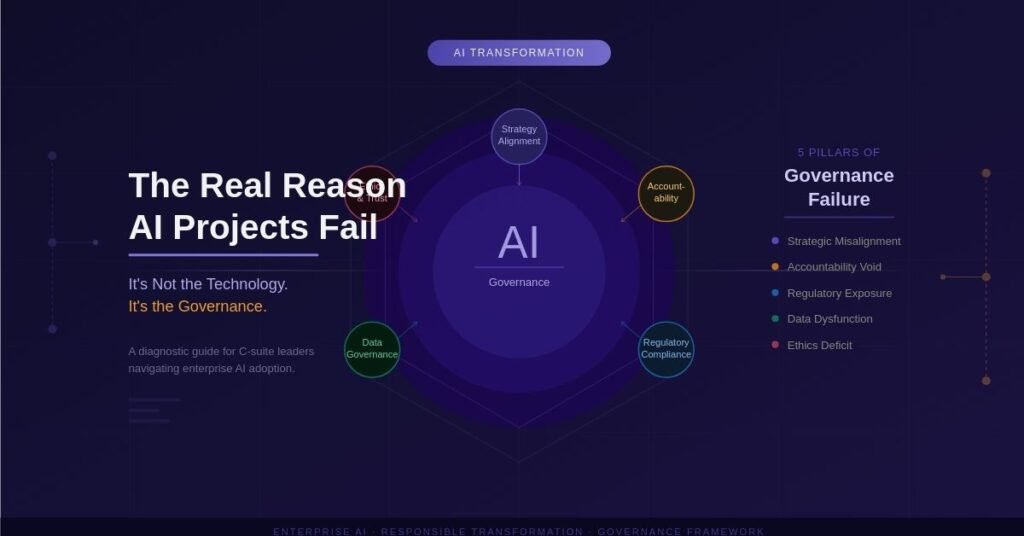
Most organizations investing in AI are asking the wrong question. They keep asking, “How do we get better AI?” when the real question is, “How do we govern the AI we already have?”
This distinction matters more than most leaders realize. According to research from Gartner and IBM, a significant majority of AI projects never make it from pilot to production. The technology often works. The governance doesn’t.
This article explains why AI transformation is fundamentally a governance problem, how to diagnose the specific failures holding your organization back, and what a practical governance framework actually looks like in action.
Why AI Projects Fail Before They Scale
The uncomfortable truth is that most AI initiatives stall not because the model was inaccurate, but because no one could agree on who owned the output, who was liable for the errors, or whether the data feeding the model was trustworthy in the first place.
This is what researchers and practitioners call the “last-mile problem” in AI transformation. You can build a sophisticated model in a controlled environment. Deploying it responsibly at enterprise scale, across departments, regulations, and real-world complexity, is an entirely different challenge.
The gap between a successful proof-of-concept and a scalable enterprise asset is almost always filled with governance questions:
- Who approves how this model is used?
- What happens when it gets something wrong?
- Does this comply with emerging regulations?
- Are we using clean, representative data?
- Can we explain the decision to a customer, a regulator, or a judge?
If your organization cannot answer these questions with confidence, your AI transformation has a governance problem.
The Mindset Shift Leaders Need to Make
From “Build First” to “Govern First”
Traditional software is largely deterministic. You write a rule, the system follows it. AI is different. It is probabilistic by nature, meaning the same input can produce different outputs, and no one, including the engineers who built it, can always predict what it will do in every scenario.
This is not a flaw. It is a fundamental characteristic of how machine learning works. But it means the entire management philosophy around AI must change.
Treating AI like conventional software is one of the most common and costly mistakes organizations make. It leads to:
- Deploying models without clear accountability structures
- Skipping bias testing because it “worked fine in the pilot”
- Ignoring regulatory exposure until a regulator comes knocking
The “govern-first” mindset treats governance not as a bureaucratic obstacle, but as the enabling infrastructure that allows AI to scale safely and sustainably.
The 5 Pillars of AI Governance Failure
Use these five dimensions as a diagnostic tool. If your organization has weaknesses in any of them, you have found where your AI transformation is breaking down.
1. Strategic Misalignment and the Shadow AI Problem
The symptom: Different teams are using AI tools independently, without coordination, oversight, or shared standards.
This is sometimes called Shadow AI, the enterprise equivalent of Shadow IT. Employees adopt consumer-grade AI tools, plug them into sensitive workflows, and no one at the leadership level knows it is happening.
The governance failure here is not that employees are using AI. It is that there is no clear enterprise-wide strategy defining acceptable use, approved tools, or data handling protocols.
Diagnostic questions to ask:
- Do you have a current inventory of every AI tool being used across departments?
- Is there an approved use policy that employees have actually read and signed?
- Does your leadership team have a unified definition of what “responsible AI use” means inside your organization?
If the answer to any of these is no, strategic misalignment is slowing your transformation.
2. The Accountability Void: Who Owns the Decision?
The symptom: When an AI system produces a harmful, biased, or incorrect output, no one can clearly identify who is responsible.
This is not just an ethical issue. In regulated industries like financial services, healthcare, and insurance, it is a legal and fiduciary one. If an AI model denies someone a loan, flags a patient as low-risk when they are not, or produces a discriminatory hiring recommendation, someone has to own that outcome.
Black-box decision-making, where neither the user nor the developer can explain why the model reached a particular conclusion, is incompatible with industries where decisions must be defensible.
The governance solution here involves two things:
- Human-in-the-Loop (HITL) protocols: Ensuring a qualified human reviews and can override AI decisions in high-stakes contexts
- Clear ownership mapping: Every AI system should have a named accountable owner, whether that is a Chief AI Officer, a risk committee, or a department head, who is responsible for its outcomes
Without this, accountability diffuses across the organization until it disappears entirely.
3. Regulatory Exposure: The EU AI Act and What It Means for You
The symptom: Your legal and compliance teams are not involved in AI deployment decisions until after the fact.
Regulation is no longer a future concern. The EU AI Act, which applies extraterritorially to any organization offering AI-enabled products or services to EU citizens, is creating compliance obligations that many US and global companies are unprepared for.
Similarly, the NIST AI Risk Management Framework (RMF) provides a voluntary but widely adopted structure for categorizing AI risk and building governance processes around it. Its four core functions, Govern, Map, Measure, and Manage, give organizations a practical backbone for operationalizing responsible AI.
The governance failure here is treating compliance as a checkbox at the end of the development cycle rather than as a design principle from the beginning.
The practical implication: Legal and compliance should have a seat at the table during AI system design, not just during deployment review.
4. Data Dysfunction: Poor Data Governance Poisons the Model
The symptom: Your AI outputs are inconsistent, biased, or inexplicably wrong, and no one can trace why.
The phrase “garbage in, garbage out” is a cliché because it is true. AI systems are only as reliable as the data used to train and run them. Poor data governance, meaning inconsistent data quality, unclear data lineage, unresolved privacy concerns, or outdated training datasets, does not just reduce model performance. It introduces systemic bias and creates regulatory exposure.
This challenge is especially acute in the public sector and large enterprises with legacy IT infrastructure. When data lives in siloed systems, lacks clear provenance, or has not been audited for representativeness, the models built on top of it inherit all of those problems invisibly.
Key data governance questions:
- Do you know exactly where your AI’s training data came from?
- Has it been audited for bias, completeness, and accuracy?
- Is there a process for detecting and responding to model drift, the gradual degradation in model performance as real-world data shifts away from training data?
Data governance is not a data science problem. It is a leadership and organizational accountability problem.
5. The Ethics Deficit: When Moving Fast Breaks Trust
The symptom: Your organization has no formal ethical framework for AI decision-making, and “responsible AI” is a phrase in a press release, not a practice in a policy document.
Trust is the asset that AI governance is ultimately protecting. When AI systems cause harm, whether through discriminatory outputs, manipulated information, or opaque automated decisions, the reputational damage is often far more costly than the immediate legal exposure.
Responsible AI (RAI) and Explainable AI (XAI) are not abstract philosophical concepts. They are practical governance disciplines that ask:
- Can we explain this model’s decision in plain language?
- Does this system treat all demographic groups fairly?
- Would we be comfortable if this decision appeared on the front page of a newspaper?
In high-stakes contexts, such as criminal justice, healthcare, credit, and employment, the ethical stakes are high enough that organizations have a social, and often legal, obligation to answer these questions before deployment, not after.
Building an AI Governance Framework That Actually Works
Diagnosis is only useful if it leads to action. Here is a practical, stepwise framework for leaders ready to close the governance gap.
Step 1: Establish Board-Level AI Literacy
Governance starts at the top. Board members and C-suite executives do not need to understand how a transformer model works. They do need to understand enough to ask the right questions, challenge assumptions, and hold teams accountable.
This might mean:
- Hiring or appointing a Chief AI Officer with a direct reporting line to the CEO
- Creating a dedicated AI risk committee at the board level
- Commissioning regular AI risk briefings in plain, non-technical language
If your board cannot articulate your organization’s AI risk exposure, governance is already failing.
Step 2: Implement the NIST AI RMF as Your Operational Backbone
The NIST AI Risk Management Framework is the most widely recognized voluntary standard for enterprise AI governance. Its four functions provide a practical operating model:
- Govern: Establish policies, roles, and culture around responsible AI
- Map: Identify the context, risks, and impacts of each AI system
- Measure: Analyze and track those risks over time
- Manage: Prioritize and respond to identified risks with appropriate controls
Treating the NIST RMF not as a compliance exercise but as a living operational discipline will give your governance program the structure and credibility it needs.
Step 3: Operationalize Responsible AI Through HITL Protocols
Human-in-the-Loop is not a philosophical stance. It is a workflow design decision.
For every high-stakes AI application, define clearly:
- At what point does a human review the AI’s recommendation?
- What authority does that human have to override the system?
- How is that override decision documented and audited?
In a loan application workflow, a human underwriter reviews any case flagged as borderline by the model. In a clinical diagnostic tool, a physician confirms or rejects the AI’s suggested diagnosis. These are not inefficiencies. They are governance mechanisms.
Step 4: Enforce Data Governance from Day One
Data governance cannot be retrofitted after a model is already in production. It must be part of the design process from the start.
This means:
- Maintaining data lineage documentation for every training dataset
- Conducting regular bias audits before and after deployment
- Establishing clear data sovereignty protocols, especially for organizations operating across jurisdictions with different privacy laws
- Creating feedback loops that allow real-world model performance data to inform retraining decisions
Step 5: Build Adaptive, Continuous Governance
Perhaps the most important insight in AI governance is this: it is not a project with an end date. It is a continuous organizational discipline.
AI systems evolve. Regulations change. Social expectations shift. A governance framework built for today’s models and today’s regulatory environment will be inadequate within 18 months.
Build governance processes that are designed to adapt:
- Conduct annual or biannual full governance reviews
- Monitor regulatory developments in key jurisdictions proactively
- Create feedback mechanisms from frontline users to governance teams so real-world problems surface quickly
Conclusion: Governance Is Your Competitive Advantage
The organizations that will win with AI over the next decade are not necessarily those with the most sophisticated models. They are the ones that deploy AI in ways that are trustworthy, accountable, and sustainable.
In a world where AI failures are increasingly public and increasingly costly, a well-governed AI operation is a genuine competitive differentiator. It builds customer trust, reduces regulatory exposure, attracts institutional investment, and creates the organizational confidence needed to scale AI ambitiously.
The question is no longer whether to govern your AI. It is whether you will govern it proactively, or reactively after something goes wrong.
The diagnostic framework in this article is your starting point. The real work is building the culture, structures, and accountability mechanisms that make governance not a burden, but a foundation.
Frequently Asked Questions
Why is AI transformation more of a governance problem than a technology problem?
Most AI projects fail not because the technology is inadequate, but because organizations lack the structures, policies, and accountability mechanisms needed to deploy AI responsibly at scale. The bottleneck is organizational, not technical.
What is Shadow AI and why is it dangerous?
Shadow AI refers to the use of AI tools by employees without organizational awareness or approval. It creates data privacy risks, compliance exposure, and unpredictable liability when things go wrong.
What is the NIST AI Risk Management Framework?
The NIST AI RMF is a voluntary framework developed by the US National Institute of Standards and Technology to help organizations identify, assess, and manage the risks associated with AI systems. Its four functions are Govern, Map, Measure, and Manage.
How does the EU AI Act affect companies outside Europe?
The EU AI Act applies to any organization providing AI-enabled products or services to individuals in EU member states, regardless of where the organization is based. This extraterritorial scope means global companies must treat EU compliance as a core governance requirement.
What does Human-in-the-Loop mean in practice?
It means designing AI workflows so that a qualified human reviews and can override AI outputs at critical decision points, particularly where those decisions carry significant consequences for individuals or organizations.
What is the “last-mile problem” in AI transformation?
It refers to the gap between successfully building an AI system in a controlled environment and deploying it responsibly at scale in the real world. Governance challenges, not technical ones, are usually what make this gap so difficult to close.

George is a digital growth strategist and the driving force behind Business Ranker, a platform dedicated to helping businesses improve their online visibility and search engine rankings. With a strong understanding of SEO, content strategy, and data-driven marketing, George works closely with brands to turn traffic into real, measurable growth.