
I’ll never forget the day a client handed me a spreadsheet with 14,000 business contacts and asked me to “just sort them by industry.” No standardized codes. No consistent naming. Just a free-text field where sales reps had typed whatever they felt like. One entry said “tech.” Another said “information technology services.” A third just said “computers, I think.”
That project took three weeks instead of three days, and it taught me something that’s stuck with me for over a decade: business vertical classification categories aren’t just bureaucratic labels. They’re the backbone of how companies target markets, allocate resources, measure performance, and actually understand who they’re selling to.
If you’ve ever struggled to segment your customer base, benchmark against competitors, or even explain what market you operate in, you’re dealing with a classification problem. And you’re not alone.
What Are Business Vertical Classification Categories?
Business vertical classification categories are standardized systems for grouping companies and organizations based on their primary economic activity, the markets they serve, or the products and services they offer. Think of them as a taxonomy for commerce — a shared language that lets everyone from government statisticians to startup founders talk about industries in a consistent way.
The word “vertical” here is key. Unlike horizontal categories (which describe functions like marketing or HR that exist across all businesses), vertical categories describe the specific market or industry a business operates in. Healthcare is a vertical. Financial services is a vertical. Agriculture is a vertical.
What most people don’t realize is that there isn’t just one classification system. There are several, each designed for different purposes, and picking the wrong one can lead you down a rabbit hole of misaligned data and wasted effort.
The Major Classification Systems You Need to Know
NAICS: The North American Standard
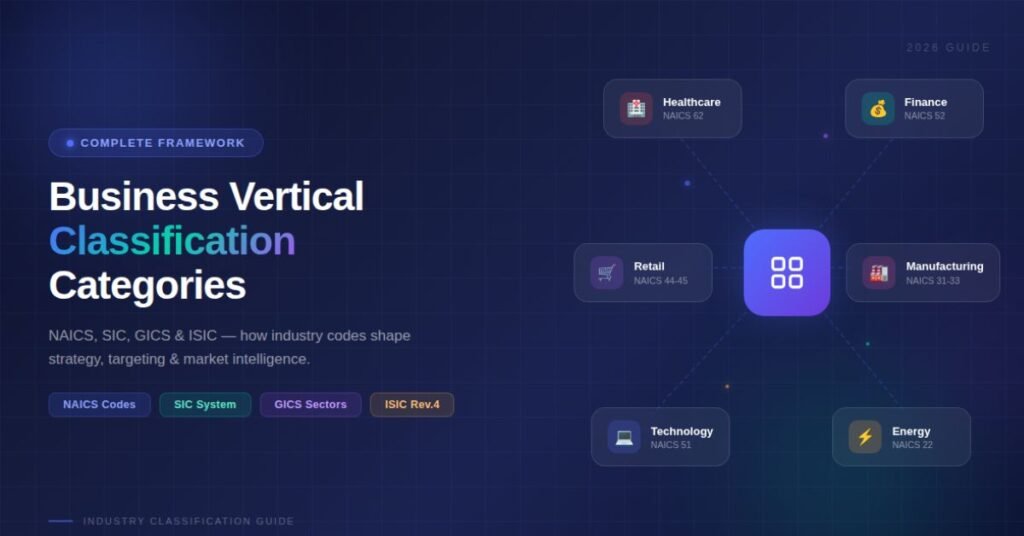
The North American Industry Classification System is the one most people in the U.S., Canada, and Mexico encounter first. Developed jointly by the three countries’ statistical agencies, NAICS replaced the old SIC system in 1997 and gets updated every five years — the most recent revision came in 2022.
NAICS uses a six-digit hierarchical code. The first two digits represent the broadest sector (like 62 for Health Care and Social Assistance), and each additional digit narrows the focus. It’s elegant in theory. In practice, I’ve found it works beautifully for manufacturing and traditional industries but struggles with companies that straddle multiple verticals — which, in 2026, is a lot of companies.
SIC Codes: Old but Not Dead
The Standard Industrial Classification system dates back to 1937. Officially, it’s been superseded by NAICS. Unofficially, it refuses to die. The SEC still uses SIC codes for filing purposes, and a surprising number of B2B databases and financial platforms still rely on them. If you’re doing any kind of competitive analysis using SEC filings, you’ll run into four-digit SIC codes whether you want to or not.
GICS: The Investor’s Framework
The Global Industry Classification Standard, developed by MSCI and S&P Dow Jones Indices, is what the financial world largely runs on. It classifies companies into 11 sectors, 25 industry groups, 74 industries, and 163 sub-industries. If you’re in investor relations or work with publicly traded companies, GICS is your language. A 2023 report from MSCI noted that over $15 trillion in assets are benchmarked against GICS-based indices.
ICB, ISIC, and Others
The Industry Classification Benchmark (ICB), used by FTSE Russell and several European exchanges, is GICS’s main competitor in financial markets. The International Standard Industrial Classification (ISIC) from the United Nations is the global equivalent of NAICS, used heavily in international trade data. There’s also NACE in the European Union, ANZSIC in Australia and New Zealand, and proprietary systems from companies like Dun & Bradstreet and Bloomberg.
Here’s the thing: none of these systems is objectively “the best.” They’re tools, and the right one depends on what you’re trying to accomplish.
Comparing the Major Systems
| Feature | NAICS | SIC | GICS | ISIC |
|---|---|---|---|---|
| Primary Use | Government statistics, regulatory | SEC filings, legacy databases | Investment, financial analysis | International trade, UN reporting |
| Geographic Scope | North America | United States (primarily) | Global | Global |
| Number of Sectors | 20 | 10 divisions | 11 | 21 |
| Granularity | 6-digit (very detailed) | 4-digit (moderate) | 8-digit (very detailed) | 4-digit (moderate) |
| Update Frequency | Every 5 years | Rarely updated | Annually reviewed | Periodic |
| Best For | Market sizing, compliance | Financial filings, legacy compatibility | Portfolio construction, benchmarking | Cross-border analysis |
| Biggest Weakness | Slow to adapt to new industries | Outdated structure | Financially biased perspective | Too broad for niche markets |
Why Vertical Classification Actually Matters for Your Business
I spent two years consulting for a mid-sized SaaS company that sold project management tools. They classified themselves as “technology” in every database, every pitch deck, every market analysis. Fair enough. But when they started losing deals to competitors, they couldn’t figure out why.
The problem? Their best customers weren’t “technology companies.” They were construction firms, architecture practices, and engineering consultancies — all in the AEC vertical. By misclassifying their own target market, they’d been benchmarking against the wrong competitors, attending the wrong conferences, and writing marketing copy that spoke to the wrong pain points.
Proper vertical classification impacts at least five critical business functions.
Market sizing and opportunity analysis. You can’t calculate your total addressable market if you can’t define your market. Classification categories give you the boundaries. According to research from McKinsey’s 2024 market analytics report, companies that use precise vertical definitions in their go-to-market strategy achieve 23% higher lead-to-close ratios than those using broad industry labels.
Sales and marketing targeting. Every CRM worth its salt lets you filter and segment by industry. But garbage in, garbage out. If your classification scheme is inconsistent, your segmentation is meaningless.
Competitive intelligence. You can’t monitor competitors if you can’t agree on who your competitors are. Classification systems define the playing field.
Regulatory compliance. Depending on your industry, you may be legally required to report your classification to government agencies. Getting it wrong isn’t just inconvenient — it can trigger audits.
Investment and valuation. Investors compare companies within verticals. Your classification affects which peers analysts use to value your business. Tom Loverro, a well-known venture investor, has written extensively about how misclassification in pitch decks immediately raises red flags for experienced VCs.
The “Vertical Stack” Framework: A Better Way to Think About Classification
Here’s something I’ve developed over the years that I haven’t seen anyone else talk about. I call it the Vertical Stack Framework, and it addresses the biggest flaw in traditional classification systems: they assume a company belongs in one box.
Modern businesses don’t live in one box. A company like Peloton isn’t just fitness equipment (NAICS 339920) — it’s also a subscription media platform, a social network, and arguably a health data company. Trying to force it into a single code misses the point entirely.
The Vertical Stack works like this. Instead of assigning one classification, you define three layers:
Layer 1 — Core Vertical. This is the industry where you generate most of your revenue today. Use the standard NAICS or GICS code. For Peloton, that’s fitness equipment.
Layer 2 — Value Chain Position. Where do you sit in your customer’s workflow? Are you infrastructure, middleware, or the end product? This matters enormously for B2B companies that serve multiple verticals but occupy the same functional position in each.
Layer 3 — Emerging Vertical. Where is your business heading? What adjacent market represents your biggest growth opportunity? This is the category investors care about, even if it’s not where you earn money today.
I used this framework with a fintech client last year, and it completely changed how their leadership team talked about strategy. Their Core Vertical was payments processing. Their Value Chain Position was middleware (they sat between merchants and banks). Their Emerging Vertical was embedded lending. Having those three labels on one slide communicated more than a 30-page market analysis.
How to Classify Your Business: A Practical Step-by-Step Guide
If you’re sitting there thinking “okay, but how do I actually do this,” here’s the process I walk clients through.
Step 1: Start with your revenue. Pull your revenue data by customer segment. Where does the money actually come from? Not where you wish it came from. Not where your founders say it comes from. Where does the money come from? Group your customers by what they do, not by who they are.
Step 2: Map to a standard system. Take your largest customer segment and look up the appropriate NAICS code using the Census Bureau’s NAICS search tool. Do the same for your second and third largest segments. If over 60% of revenue comes from one vertical, that’s your primary classification.
Step 3: Validate against competitors. Find 5-10 companies you genuinely compete with for the same customers. Check their classifications in SEC filings (for public companies) or databases like Crunchbase or PitchBook. If your classification doesn’t match any of your real competitors, something’s off.
Step 4: Pressure-test with your sales team. Ask your best salespeople: “When you’re on a call with a prospect, what industry do they say they’re in?” Sales reps hear this language every day. They know how your market self-identifies, which is often different from how statistical agencies categorize it.
Step 5: Document and standardize. Create a single source of truth — a one-page document that states your primary classification, the system you’re using, and why. Distribute it to marketing, sales, finance, and investor relations. Update it annually.
This process sounds simple. It isn’t. Step 1 alone requires honest internal conversations that many leadership teams would rather avoid. But I’ve seen companies waste millions on misdirected marketing campaigns because nobody took the time to do this basic work.
Common Classification Mistakes (And How to Avoid Them)
Vanity classification. This is when companies classify themselves based on aspiration rather than reality. A staffing agency calling itself “AI-powered workforce solutions” and filing under software development doesn’t fool anyone. Well, it might fool a CRM algorithm, but it won’t fool actual buyers.
Over-narrowing. Some businesses pick the most niche code they can find, thinking specificity signals sophistication. But if your category has only twelve companies in it, your market sizing data becomes meaningless because sample sizes are too small for reliable analysis.
Classification drift. Your business evolves. Your classification should evolve with it. I’ve seen companies using the same SIC code from their incorporation paperwork fifteen years ago, even though they’ve completely pivoted their business model. Set a calendar reminder to review your classification every January.
Ignoring multi-vertical complexity. A McKinsey analysis from 2023 found that 40% of S&P 500 companies generate significant revenue from at least two distinct industry verticals. If you’re one of them and you’re only using one classification code, your competitive intelligence and benchmarking are flawed by definition.
Industry Verticals That Are Reshaping Traditional Categories
The classification systems we use today were designed for an economy that was more neatly divided than the one we live in now. Several emerging verticals are challenging the entire framework.
Climate tech spans energy, manufacturing, agriculture, transportation, and finance. There’s no single NAICS code for it, and there probably shouldn’t be — but that makes market analysis incredibly difficult.
Digital health sits at the intersection of healthcare delivery, software, medical devices, and consumer wellness. The 2022 NAICS update added some codes for telehealth, but the category remains fragmented.
Creator economy businesses don’t fit neatly into media, technology, or professional services. Platforms like Patreon and Substack have characteristics of all three.
Embedded finance is another one. When a non-financial company starts offering loans or insurance products, does it reclassify? Technically, some regulators say yes. Practically, almost nobody does.
These category-spanning businesses represent the frontier of classification challenges. If you operate in one of these spaces, expect to spend extra time explaining your vertical to investors, partners, and analysts who are still thinking in traditional boxes.
Tools and Resources for Business Classification
A few tools I’ve personally used and can recommend:
The U.S. Census Bureau NAICS Search is the definitive free resource for finding NAICS codes. It’s clunky but accurate. The SEC EDGAR Full-Text Search system lets you look up SIC codes for any publicly traded company. Crunchbase and PitchBook both offer proprietary industry classification that’s more modern than NAICS but less standardized — useful for startup ecosystems. IBISWorld publishes industry reports organized by NAICS codes that are genuinely useful for market sizing, though the subscription cost is significant. For international work, the UN Statistics Division’s ISIC registry is the starting point.
One honest caveat: every database has classification errors. I’ve found wrong SIC codes in SEC filings, miscategorized companies in CRM platforms, and bizarre NAICS assignments that clearly resulted from someone clicking the wrong dropdown menu. Always verify classifications from multiple sources before making strategic decisions based on them.
Frequently Asked Questions
What’s the difference between a business vertical and a business horizontal?
A business vertical refers to a specific industry or market niche — like healthcare, finance, or retail. A business horizontal refers to a function or service that cuts across multiple industries, like cloud computing, human resources, or cybersecurity. The distinction matters because vertical-specific strategies target industry pain points, while horizontal strategies emphasize universal business needs.
How often should a company update its industry classification?
Most experts recommend reviewing your business classification annually, and updating it whenever your primary revenue source shifts meaningfully. The NAICS system itself updates every five years, with the last revision in 2022, so major reclassification opportunities arise on that cycle as well.
Can a business belong to more than one vertical classification category?
Yes, and many do. Large conglomerates and diversified businesses routinely report under multiple NAICS or SIC codes. Even smaller companies often straddle two verticals. The key is identifying your primary classification based on revenue, while acknowledging secondary verticals in your strategic planning and market analysis.
Which classification system should a startup use?
For most U.S.-based startups, start with NAICS because it’s what government databases, grant applications, and many investors expect. If you’re seeking institutional investment, also identify your GICS sub-industry, since that’s the language financial analysts speak. Proprietary systems from platforms like Crunchbase can supplement these but shouldn’t replace them.
How do business vertical categories affect SEO and digital marketing?
Vertical classification directly influences keyword strategy, content targeting, and audience segmentation. When you know your vertical precisely, you can target industry-specific search terms, create content that resonates with vertical-specific pain points, and build backlink profiles from authoritative sources within your industry. Misclassification leads to wasted ad spend and content that doesn’t convert.
The real takeaway here isn’t that you need to memorize classification codes. It’s that clarity about where your business fits in the broader economic landscape affects almost every strategic decision you make. I’ve watched companies transform their go-to-market results simply by getting honest about their vertical. It’s not glamorous work. But it’s foundational — and the businesses that do it well have an invisible advantage over those that don’t.

George is a digital growth strategist and the driving force behind Business Ranker, a platform dedicated to helping businesses improve their online visibility and search engine rankings. With a strong understanding of SEO, content strategy, and data-driven marketing, George works closely with brands to turn traffic into real, measurable growth.