
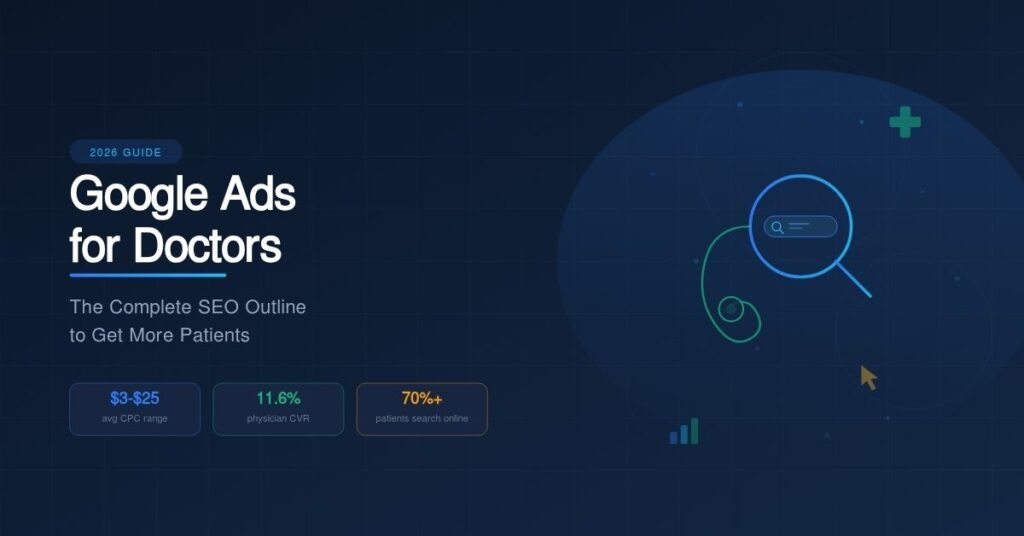
Your Practice Is Invisible to the Patients Who Need You Most
Right now, someone within five miles of your office is Googling “knee pain specialist near me.” They’re not browsing. They’re not “doing research” in some vague, leisurely way. They have a problem, and they want it solved today.
If your practice doesn’t appear in both the paid results and the organic listings for that search, you’re handing that patient to whoever does.
Here’s the part most marketing guides won’t say plainly: running Google Ads without an SEO foundation is expensive and fragile. Building SEO without using Google Ads data is slow and blind. The practices dominating patient acquisition in 2026 are running both — and they’re treating them as one integrated system, not two separate budgets.
This guide gives you the actual outline — the strategic framework — for combining Google Ads and SEO into a patient acquisition system built for how healthcare search works right now. We’ll cover real cost benchmarks, keyword strategy, compliance landmines, landing page requirements, and the specific tactics that differ by medical specialty.
Whether you’re a solo practitioner deciding if this is worth the investment or a multi-location group evaluating your agency’s work, this is the blueprint.
Why Google Ads and SEO Belong in the Same Conversation
Most guides treat Google Ads and SEO as competing channels. That’s a fundamental misunderstanding of how patients actually find doctors.
The patient journey in healthcare doesn’t follow a neat funnel. A patient might see your Google Ad on Monday, click away, then search organically on Wednesday, read your blog post, check your reviews, and finally book on Friday. If you’re only investing in one channel, you’re only present for part of that journey.
The integrated approach works because each channel feeds the other:
Google Ads generates immediate traffic and — critically — keyword data. You can see exactly which search terms drive appointment bookings within weeks. That data is gold for your SEO strategy. Instead of guessing which pages to build, you build content around terms that are already converting in paid search.
SEO, in turn, reduces your long-term cost per patient. As organic rankings improve for your highest-converting keywords, you can strategically reduce ad spend on those terms and reallocate budget to new service lines or higher-competition specialties.
Google’s algorithm also rewards this integration indirectly. A practice with strong organic presence, a well-optimized Google Business Profile, and high-quality ad landing pages sends consistent trust signals. Your Quality Score improves. Your cost per click drops. Your ad position rises — even at lower bids.
This isn’t theoretical. It’s measurable. And it’s why the outline below treats Google Ads and SEO as one system, not two projects.
How Patients Actually Search for Doctors in 2026
Before touching a keyword tool or setting a bid, you need to understand how patients search. It’s different from how they shop for shoes or software.
Healthcare searches are emotional, urgent, and local. A parent searching “pediatric urgent care open now” at 11 PM is in a completely different mindset than someone comparison-shopping for CRM software. The intent is sharper. The tolerance for irrelevant results is zero. The conversion window is hours, not weeks.
Most medical searches follow a few patterns. There are condition-based queries (“what causes sharp pain in lower back”), provider-based queries (“orthopedic surgeon near me”), and action-based queries (“book same day dentist appointment”). Each pattern requires a different ad and content strategy — and most practices lump them all together into one generic campaign, which is why their cost per lead balloons.
Mobile dominates healthcare search. Many of these queries happen from phones — in waiting rooms, parking lots, or at 2 AM when anxiety peaks. Voice search is increasingly common, especially for urgent care and symptom-related queries. That matters for keyword strategy: voice searches tend to be longer and more conversational (“where can I find a dermatologist who takes Blue Cross near downtown”).
The critical takeaway: patients don’t search like marketers expect. They search like people under stress. Your campaigns need to match that reality.
The Google Ads Strategy Outline for Medical Practices
Campaign Architecture: Structure Before Spend
The single biggest mistake doctors make with Google Ads is poor campaign structure. They create one campaign, dump fifty keywords into it, point everything to their homepage, and wonder why they’re paying $15 per click with no appointments to show for it.
A proper structure for a medical practice looks like this:
Campaign Level — Organize by Service Line. Each major service gets its own campaign. A dermatology practice would have separate campaigns for acne treatment, skin cancer screening, cosmetic procedures, and general dermatology. This gives you granular budget control. If cosmetic procedures have a higher patient lifetime value, you can allocate more budget there without starving your other campaigns.
Ad Group Level — Organize by Intent Cluster. Within each campaign, ad groups should be tightly themed around specific patient intents. For a “knee replacement” campaign, you’d have separate ad groups for “knee replacement surgeon near me,” “knee replacement cost,” and “knee replacement recovery time.” One clear intent per ad group. This is non-negotiable for maintaining a high Quality Score.
Keyword Level — Precision Over Volume. For most medical practices, exact match and phrase match keywords do the heavy lifting. Broad match has its place, but only when paired with aggressive negative keyword lists and sufficient conversion data for Google’s algorithm to optimize against.
Keyword Research: Finding What Patients Actually Type
Start with Google Keyword Planner, but don’t stop there. Patient review sites like Healthgrades and Zocdoc reveal how patients describe their needs in plain language. Patients search “bone doctor for back pain,” not “orthopedic spinal specialist.”
High-intent keywords to prioritize:
- “[Specialty] near me” and “[Specialty] in [City]”
- “[Condition] doctor accepting new patients”
- “[Procedure] cost” and “[Procedure] specialist”
- “Same day [specialty] appointment”
- “[Insurance provider] [specialty] near me”
Negative keywords to add immediately: Terms like “free,” “home remedy,” “salary,” “jobs,” “school,” “degree,” “malpractice,” and “lawsuit” should be blocked from day one. These clicks drain budget on people who will never book an appointment. Review your search terms report weekly for the first 60 days — this single habit can save 15–25% of your budget.
Bidding Strategy: Match Your Approach to Your Data
If you’re just starting (fewer than 30 conversions/month): Use Manual CPC or Maximize Clicks with a bid cap. You need data before you can let Google’s algorithm optimize. Set realistic daily budgets and resist the urge to go aggressive.
If you have 30+ tracked conversions: Switch to Target CPA bidding. Tell Google your target cost per lead — say, $50 if an average appointment is worth $250 — and let the algorithm optimize. This works well for established campaigns with consistent conversion patterns.
If you have strong conversion data and want scale: Maximize Conversions or Target ROAS bidding can push volume, but watch your cost per lead closely. Healthcare CPCs vary wildly by specialty and market. Don’t assume what works for a dermatologist in Omaha will work for an orthopedic surgeon in Manhattan.
Ad Copy That Converts Patients, Not Just Clicks
In healthcare, your ad copy needs to do two things simultaneously: match the patient’s urgent intent and establish enough trust for them to click. That’s a harder balance than most industries.
What works in medical ad copy:
Specificity beats vagueness. “Board-Certified Knee Specialist — Same Week Appointments” outperforms “Leading Orthopedic Practice” every time. The first ad tells the patient exactly what they get. The second could be anyone.
Include trust signals in your headlines. Board certifications, years of experience, “accepting new patients,” and insurance acceptance all earn clicks. Patients scanning Google results are making trust decisions in milliseconds.
Use ad assets (formerly extensions) aggressively. Call extensions, location extensions, sitelink extensions pointing to specific service pages, and structured snippets listing your specialties. These aren’t optional extras — they increase your ad’s visual footprint on the SERP and improve click-through rate.
Run at least two ad variations per ad group. Test different headlines and calls to action. Let data — not gut feeling — decide the winner.
The SEO Outline for Medical Practices
Technical SEO: The Foundation Nobody Wants to Talk About
Before writing a single blog post or optimizing a service page, your website’s technical foundation needs to be solid. For medical practices, this includes:
Site speed matters more than you think. A patient searching on their phone at midnight won’t wait three seconds for your page to load. Google uses Core Web Vitals as a ranking factor, and healthcare sites tend to be heavy with images and third-party booking widgets. Compress images, lazy-load below-the-fold content, and test your mobile speed regularly.
Schema markup is your secret weapon. Implement MedicalOrganization, Physician, and LocalBusiness structured data. Add FAQ schema to your Q&A content. This helps Google understand what your practice offers and can earn you rich snippets — the enhanced search results that dominate clicks.
HTTPS is mandatory. This should be obvious in 2026, but an alarming number of medical practice websites still have mixed content warnings or expired certificates. For a healthcare site, this is a trust killer — both for patients and for Google’s YMYL quality assessment.
Content Strategy: Service Pages, Not Just Blog Posts
The backbone of medical practice SEO isn’t your blog. It’s your service pages. Each condition you treat and each procedure you offer deserves a dedicated, well-optimized page.
What a high-performing medical service page includes:
A clear, keyword-aligned H1 that matches how patients search (e.g., “ACL Surgery in [City] — Dr. [Name]”). An opening paragraph that addresses the patient’s concern directly. A section explaining the condition or procedure in patient-friendly language. Information about what to expect (consultation, procedure, recovery). Doctor credentials and relevant experience. A clear, prominent call to action — ideally an embedded scheduling widget or click-to-call button.
These pages should be written for patients, not for other doctors. Medical jargon kills conversion rates and sends patients back to Google.
Local SEO: Where Most Patient Searches Begin
For medical practices, local SEO isn’t a “nice to have” — it’s the primary organic channel. When someone searches “dentist near me,” Google serves a local map pack before any traditional organic results.
Google Business Profile optimization is critical. Complete every field. Add high-quality photos of your practice (not stock images). Post updates regularly. Respond to every review — positive and negative. Ensure your name, address, and phone number (NAP) are identical across every directory, website, and social profile.
Build location-specific pages if you serve multiple areas. A page optimized for “family doctor in [Neighborhood]” with location-specific content performs significantly better than a generic “Our Locations” page with a list of addresses.
Reviews are a ranking factor and a trust factor. Actively request reviews from satisfied patients. Google Business Profile reviews directly influence local pack rankings, and they’re often the deciding factor when a patient is choosing between two practices.
Google Ads vs. SEO vs. Local Service Ads: A Direct Comparison
| Factor | Google Search Ads | SEO (Organic) | Local Service Ads (LSAs) |
|---|---|---|---|
| Time to results | Days to weeks | 3–6 months minimum | 1–2 weeks after approval |
| Cost model | Pay per click (CPC) | Time/labor investment | Pay per lead |
| Average cost | $3–$15+ per click (varies by specialty) | $1,500–$5,000+/mo for agency SEO | $6–$30 per lead |
| Best for | Immediate visibility, testing keywords | Long-term patient volume, authority | Local trust, phone-call-based leads |
| Control | High (bids, targeting, scheduling) | Moderate (content, technical factors) | Low (Google controls matching) |
| Trust signals | Dependent on landing page quality | Built through content and reviews | Google Guaranteed/Screened badge |
| Ideal practice stage | New practices or new service lines | Established practices building authority | Any practice wanting phone leads |
| HIPAA risk | Moderate (tracking, forms) | Low | Low |
The practices winning in 2026 use all three where applicable — but allocate budget based on where each channel performs strongest for their specific specialty and market.
Healthcare Ad Compliance: The Guardrails You Can’t Ignore
Medical advertising on Google operates under stricter rules than almost any other industry. Google classifies healthcare as YMYL content, which means your ads and landing pages face elevated scrutiny from both automated systems and human quality raters.
Common reasons medical ads get disapproved:
Making unsubstantiated health claims. You cannot promise outcomes, guarantee cures, or use “before and after” language without careful qualification. Google’s automated review catches this quickly, and manual reviews catch what automation misses.
Targeting or implying targeting based on health conditions. Google’s personalized advertising policies restrict how you can target users based on medical conditions. You can target keywords, but you cannot create audience segments based on health data.
Missing certifications for restricted services. Certain healthcare categories — including addiction treatment, pharmaceuticals, and some cosmetic procedures — require Google certification before you can run ads.
Landing page violations. If your landing page makes claims your ad doesn’t, or if your forms collect sensitive health information without proper privacy disclosures, your ads can be disapproved or your account suspended.
HIPAA considerations for Google Ads: Conversion tracking in healthcare requires care. Standard Google Ads tracking pixels can inadvertently transmit protected health information (PHI) if your booking forms capture medical details. Use HIPAA-compliant form providers, configure conversion tracking to fire on confirmation pages rather than form fields, and consult with a compliance professional before implementing any tracking that touches patient data.
Real Cost Benchmarks: What Doctors Actually Pay in 2026
Let’s cut through the vague “it depends” language. Here are real ranges based on current benchmark data.
Cost-per-click by specialty (approximate ranges):
| Specialty | Typical CPC Range | Notes |
|---|---|---|
| Primary Care / Family Medicine | $3–$8 | Lower competition, high volume |
| Dentistry (General) | $5–$12 | Moderate competition |
| Dental Implants / Cosmetic Dentistry | $8–$20 | High-value procedures, competitive |
| Dermatology | $5–$15 | Varies by procedure type |
| Orthopedic Surgery | $8–$18 | Higher CPC, higher patient value |
| Plastic Surgery / Cosmetic | $10–$25+ | Very competitive in metro areas |
| Mental Health / Therapy | $4–$12 | Growing demand, rising CPCs |
| Urgent Care | $5–$15 | Strong local intent |
[Sources: WordStream 2025 Google Ads Benchmarks; WebFX 2026 Google Ads Cost Analysis; StubGroup Healthcare Compliance Guide]
Monthly budget ranges for medical practices:
Solo practitioners and small practices typically allocate $1,500 to $4,000 per month across search and display. Mid-sized groups and multi-location practices commonly invest $4,000 to $10,000+ depending on specialties and service areas. These are advertising budgets only — they don’t include agency management fees, which typically run 15–20% of ad spend or a flat monthly retainer.
The number that matters most: cost per booked appointment. A $12 CPC means nothing if it takes 25 clicks to generate one appointment ($300 per patient) versus 8 clicks ($96 per patient). Track conversions ruthlessly, and optimize toward cost per appointment — not cost per click.
Landing Pages: Where Most Healthcare Ad Budgets Go to Die
You can have perfect keywords, precise targeting, and compelling ad copy. If you send that traffic to your homepage — or worse, a generic “About Us” page — you’re lighting money on fire.
Every ad group needs a dedicated landing page. If your ad promises “Same-Day Root Canal in [City],” the landing page should be about same-day root canals in that city. Not your full list of dental services. Not your team bios. The specific thing the patient searched for.
What a high-converting medical landing page includes:
A headline that matches the ad exactly (message match). If the ad says “Board-Certified Dermatologist — Accepting Aetna,” the landing page headline should reinforce that specific promise.
Proof of credibility above the fold. Board certifications, years of experience, hospital affiliations, and patient review scores. Patients make trust decisions in seconds.
A frictionless booking mechanism. An embedded scheduling widget, a short HIPAA-compliant form (name, phone, reason for visit), or a prominent click-to-call button. Every additional field you add to a form reduces conversion rate. Keep it minimal.
Patient testimonials — ideally video. Static text reviews still work, but short video testimonials where patients share their experience are significantly more effective at building trust. A 30-second patient video outperforms a wall of five-star text reviews.
Mobile optimization is not optional. The majority of healthcare searches happen on phones. If your landing page requires pinching, zooming, or horizontal scrolling, your conversion rate will crater.
Myth vs. Fact: Google Ads for Doctors
| Myth | Fact |
|---|---|
| “Google Ads is too expensive for a small practice.” | Budget is fully controllable. A solo practice can start with $50/day and scale based on results. The question isn’t cost — it’s whether the cost per patient is profitable. |
| “SEO makes Google Ads unnecessary.” | They serve different timelines and functions. SEO builds long-term equity. Ads generate immediate visibility. The best practices run both. |
| “Broad match keywords reach more patients.” | Broad match without strong negatives reaches more irrelevant searchers. Tight keyword targeting with exact and phrase match typically produces better cost per lead. |
| “You can just send traffic to your website homepage.” | Homepage traffic from ads converts poorly. Dedicated landing pages with message match and clear CTAs routinely double or triple conversion rates. |
| “Once you set up a campaign, it runs itself.” | Google Ads requires ongoing optimization. Search term review, bid adjustment, ad testing, and negative keyword updates should happen weekly, especially in the first 90 days. |
| “Patients don’t click on ads.” | Data consistently shows that ad clicks account for a significant share of high-intent healthcare searches. When someone needs a doctor now, they click what’s at the top. |
Playbook for Healthcare Content
Google holds healthcare websites to its highest quality standard. Your Money or Your Life (YMYL) content — anything that could impact a person’s health, safety, or financial stability — requires demonstrable E-E-A-T signals. For medical practices, this isn’t abstract. It directly affects whether your pages rank.
How to build E-E-A-T into your content and campaigns:
Experience: Share first-person clinical insights. A page about knee replacement written by an orthopedic surgeon who has performed 2,000 procedures carries more weight than the same content written by a content mill. If your doctor has direct experience with a condition or procedure, say so explicitly.
Expertise: Display credentials prominently — on every service page, on your About page, and in your ad landing pages. Board certifications, fellowship training, publications, and speaking engagements all signal expertise to both patients and Google’s quality raters.
Authoritativeness: Earn mentions and links from recognized medical organizations, hospital systems, and health publications. Being cited as a source by local news outlets covering health topics builds authority signals that Google’s algorithm tracks.
Trustworthiness: HIPAA compliance, clear privacy policies, transparent pricing (where applicable), accurate NAP information, and genuine patient reviews all contribute. A medical website with no author attribution, no privacy policy, and stock photos sends the opposite signal.
From the field: Having managed digital marketing for medical practices across multiple specialties, the most common E-E-A-T failure we see is practices using generic, outsourced content with no physician attribution. Google can detect this. In 2025 and 2026, practices that switched from anonymous blog content to physician-authored or physician-reviewed content saw measurable ranking improvements within 8–12 weeks — particularly for competitive procedure-related keywords. The content doesn’t need to be literary. It needs to be real.
Specialty-Specific Considerations
Dentists: Dental searches have some of the highest commercial intent in healthcare. Patients searching for “dental implants” or “Invisalign” are often ready to commit. Prioritize procedure-specific campaigns over general dentistry. Landing pages for cosmetic dentistry should include before-and-after galleries (compliant with Google’s policies) and financing options.
Mental Health Providers: This space has unique sensitivities. Google restricts certain targeting for mental health services. Ad copy must be careful with condition-specific language. On the SEO side, blog content addressing common mental health questions drives significant organic traffic and builds trust before the patient ever picks up the phone.
Surgeons and Specialists: Higher CPC but higher patient lifetime value. Focus on procedure-specific long-tail keywords. “Rotator cuff surgery recovery time” captures patients deep in the decision process. These patients often research extensively — longer content with detailed procedural information performs well for both SEO and landing page conversions.
Urgent Care and Walk-In Clinics: Speed is everything. Ad scheduling should match operating hours precisely. Location targeting should be tight — typically a 5–10 mile radius. Landing pages should prominently feature current wait times, accepted insurance, and a click-to-call button that’s impossible to miss.
Measuring What Matters: Tracking and Attribution
Without conversion tracking, Google Ads for a medical practice is guesswork. And in healthcare, tracking is more complicated than installing a pixel and calling it done.
Essential conversions to track:
Phone calls from ads (using call tracking with dynamic number insertion). Form submissions (HIPAA-compliant forms only). Online appointment bookings. Click-to-call from mobile. Direction requests from Google Business Profile.
The attribution challenge: Patients often interact with multiple touchpoints before booking. They might click an ad, leave, return via organic search, and then call. Single-touch attribution (giving all credit to the last click) undervalues both your ad spend and your SEO investment. If your analytics setup supports it, use data-driven attribution to understand how channels work together.
Review search term reports religiously. This is where you discover which actual searches triggered your ads. You’ll find gold (high-intent terms you hadn’t targeted) and garbage (irrelevant queries burning budget). Weekly review for the first 60 days, bi-weekly after that.
Frequently Asked Questions
How much should a doctor spend on Google Ads per month?
Most solo and small practices can start meaningfully at $1,500 to $3,000 per month in ad spend, plus management costs. The right budget depends on your specialty’s average CPC, your local competition, and how many new patients you need. Start conservative, track cost per booked appointment, and scale what works.
Do Google Ads work for small medical practices?
Yes — and often better than for large practices. Small practices can target hyper-locally, focus budget on one or two high-value services, and move faster than large organizations. The key is precise targeting and dedicated landing pages rather than broad, high-budget campaigns.
How long does it take for medical SEO to show results?
Organic SEO for a medical practice typically takes three to six months to show meaningful ranking improvements, sometimes longer in competitive markets. Google Ads can generate patient inquiries within the first week. That’s why the integrated approach works: ads provide immediate patients and data while SEO builds sustainable traffic over time.
What is a good cost per lead for a medical practice?
This varies significantly by specialty and market. General benchmarks suggest $16 to $80+ per lead depending on the service. The real metric is cost per booked appointment — which accounts for lead quality. A $75 lead that books a $3,000 procedure is far more valuable than a $20 lead that never shows up.
Should doctors manage Google Ads themselves or hire an agency?
It depends on your time and expertise. Google Ads for healthcare involves compliance considerations, ongoing optimization, and data analysis that most doctors don’t have time for between patients. If you hire an agency, look for one with healthcare-specific experience, transparent reporting, and a clear understanding of HIPAA implications in ad tracking.
How do Google’s AI Overviews and SGE affect doctor advertising?
Google’s AI-generated search results are changing how users interact with the SERP. For informational health queries, AI Overviews may reduce clicks to individual websites. For high-intent local searches (“dentist near me”), the impact is less pronounced — patients still need to click through to book. The best defense is strong local SEO, compelling ad copy, and content authoritative enough that Google cites you as a source within its AI-generated answers.
What Comes Next: Building Your Patient Acquisition System
The practices that will thrive over the next few years aren’t the ones with the biggest ad budgets. They’re the ones running Google Ads and SEO as a single, data-driven system — where paid search insights inform organic content strategy, where landing pages serve both channels, and where every dollar is measured against actual appointments booked.
Here’s your immediate action plan:
This week: Audit your current Google Business Profile. Complete every field. Add recent photos. Respond to outstanding reviews. This is the fastest, cheapest win in healthcare marketing.
This month: Set up proper conversion tracking — phone calls, form submissions, and online bookings. You cannot optimize what you don’t measure.
This quarter: Launch your first structured Google Ads campaign using the outline above. Start with your highest-value service line, exact and phrase match keywords, and a dedicated landing page. Simultaneously, begin building out service-specific SEO pages using the same keyword insights.
Ongoing: Review search term reports weekly. Test ad copy monthly. Publish or update one physician-authored content piece per month. Adjust bids based on cost per booked appointment, not cost per click.
The patients are already searching. The only question is whether they’re finding you — or the practice down the street.

George is a digital growth strategist and the driving force behind Business Ranker, a platform dedicated to helping businesses improve their online visibility and search engine rankings. With a strong understanding of SEO, content strategy, and data-driven marketing, George works closely with brands to turn traffic into real, measurable growth.