
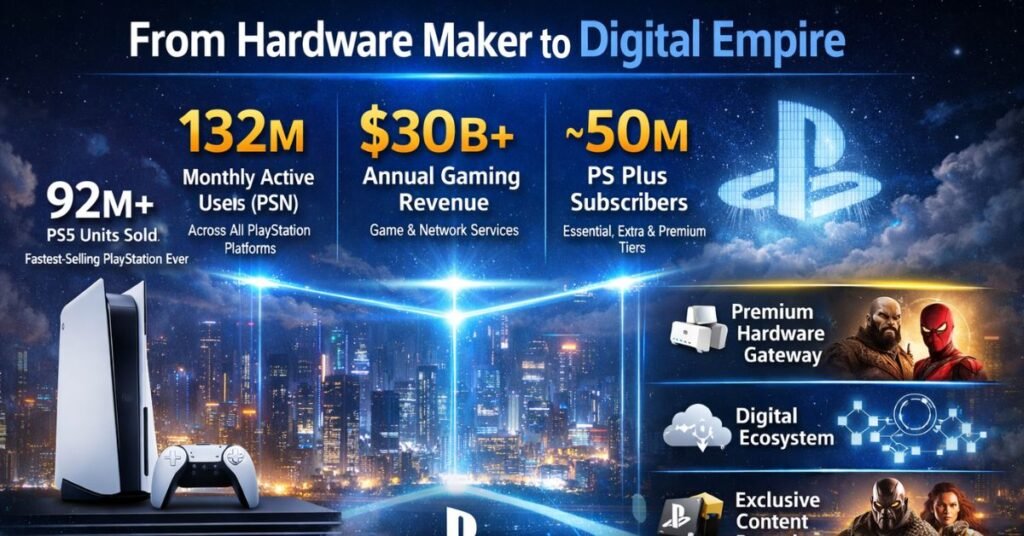
| 92M+ | PS5 Units Sold (as of 2025) | Fastest-selling PlayStation ever |
| 132M | Monthly Active Users (PSN) | Across all PlayStation platforms |
| $30B+ | Annual Gaming Revenue | Game & Network Services segment |
| ~50M | PS Plus Subscribers | Across Essential, Extra & Premium tiers |
Introduction: From Hardware Maker to Digital Empire
For most of its history, Sony’s PlayStation division was defined by a single question: can we build a better console than the competition? From the PS1’s CD-ROM revolution in 1994 to the Cell processor gamble of the PS3 era, Sony’s identity was anchored in hardware engineering. That era is over — not because consoles no longer matter, but because Sony has fundamentally redefined what they are for.
The PlayStation platform business today is best understood as a digital ecosystem that uses hardware as an entry point, not an end goal. The real business — the one that generates recurring revenue, earns investor confidence, and sustains long-term market standing — lives in the cloud, in subscriptions, in microtransactions, and in an ever-expanding digital storefront that reaches well beyond the living room. This is the transformation that defines modern PlayStation strategy.
The Core Thesis: The Engagement Model Explained
Sony’s leadership now explicitly frames its gaming division around what it calls an “engagement model.” The premise is straightforward: the more time a user spends inside the PlayStation ecosystem, the more revenue that user generates — and the less likely they are to leave. Rather than optimizing for console units shipped, Sony optimizes for Monthly Active Users (MAUs) and Average Revenue Per User (ARPU).
Monthly Active Users (MAUs): At 132 million, PlayStation Network’s active user base is the foundation of the entire digital economy. Each MAU represents a potential subscriber, a digital storefront customer, and a live-service participant.
Average Revenue Per User (ARPU): Sony works to increase this metric by deepening the range of monetized touchpoints — from PS Plus subscriptions and PS Store purchases to DLC bundles and in-game transactions.
Recurring Revenue: Subscriptions and live-service titles create predictable, compounding income streams that investors and analysts increasingly favor over one-time hardware sales.
This shift represents more than a business model update — it is a philosophical transformation. Hardware remains essential, but it is now the vehicle, not the destination.
The Three Pillars of the PlayStation Platform
Pillar 1: Hardware as the Premium Gateway
The console has not lost its importance — it has changed its job description. Where the PS1, PS2, and even PS4 were judged primarily on their commercial success as devices, the PS5 and its successors are evaluated on how effectively they funnel high-value users into the broader ecosystem. In this context, the hardware is a premium gateway: a high-quality entry point designed to attract committed players who will then spend deeply on digital content.
This reframing has significant pricing implications. Sony has shown increasing willingness to price the PS5 at levels that reflect its premium positioning rather than aggressively targeting market share at launch. Component costs — particularly during the global semiconductor shortage — made aggressive pricing untenable anyway, but the deeper strategic logic is that a slightly smaller, more engaged install base can generate more revenue than a massive base of occasional players.
The PS5 Pro, released as an incremental hardware upgrade, underlines this approach. Rather than a full console generation reset, it targets the most enthusiastic segment of the existing user base — players willing to invest in higher fidelity who are also, by definition, already deeply embedded in the PlayStation ecosystem.
The Evolving Role of Peripherals: PS VR2 and PlayStation Portal
PlayStation’s peripheral strategy is another lens through which to view the engagement model. PlayStation VR2 and the PlayStation Portal remote play device are not mass-market products — they are ecosystem deepening tools. Each peripheral increases the time a committed user spends within the PlayStation environment, which in turn increases lifetime value and reduces the probability of platform exit.
PlayStation VR2, despite modest commercial performance relative to its ambitions, signals Sony’s long-term interest in immersive gaming as both a differentiation tool and a future revenue frontier. PlayStation Portal, conversely, is a pragmatic product: it extends the PS5 experience beyond the living room, keeping users engaged during periods they might otherwise drift to competing platforms or services.
Pillar 2: The Digital Empire — PSN and Network Services
If the PS5 is the gateway, the PlayStation Network is the city inside. PSN is the central infrastructure of Sony’s digital empire, and it is the most important revenue engine in the entire business. Every digital transaction — software purchase, subscription renewal, DLC pack, in-game currency bundle — flows through this platform, and Sony collects a standard 30% platform fee on third-party transactions.
The PlayStation Store, PSN’s digital storefront, has benefited enormously from the broader industry shift to digital distribution. Sony reports that roughly 75-80% of PS5 software sales are now digital, compared to a predominantly physical market in the PS3 era. This structural change is extraordinarily valuable: digital margins are materially higher than physical, there are no retailer revenue shares, and digital users are more likely to purchase DLC and in-game content.
Live-service games have become a key pillar of the digital economy. Titles like Fortnite and Call of Duty funnel enormous volumes of microtransaction revenue through the PlayStation Store. Although Sony does not develop these titles, it captures a meaningful share of every transaction made on its platform. This is classic platform economics — and it is why Sony’s network services segment generates such significant operating leverage.
Key Network Revenue Streams:
- Digital software sales (full-game downloads from the PlayStation Store)
- PS Plus subscription tiers: Essential, Extra, and Premium
- 30% platform fee on third-party in-game purchases, DLC, and content packs
- Microtransactions and in-game currencies across both first- and third-party titles
- PlayStation Stars loyalty program engagement and premium rewards
Pillar 3: Content as a Moat — PlayStation Studios
The third pillar is perhaps the most visible to consumers, and the most strategically distinctive: PlayStation’s portfolio of first-party studios. Sony’s investment in PlayStation Studios — comprising legendary developers like Naughty Dog, Insomniac Games, Santa Monica Studio, Guerrilla Games, and Bend Studio — represents a long-term bet that exclusive content is the most durable form of competitive moat available to a platform owner.
This thesis has been validated repeatedly. God of War: Ragnarok, Marvel’s Spider-Man 2, The Last of Us franchise, and Demon’s Souls are not merely commercial successes — they are system-selling franchises. They create the initial justification for hardware purchase and, once a user has bought in, they create emotional loyalty that is very difficult for a competitor to displace.
The intellectual property created by PlayStation Studios also has value that extends well beyond the platform itself. The HBO adaptation of The Last of Us demonstrated the cross-media potential of Sony’s gaming IP in the most commercially visible way possible, driving new platform interest and reinforcing the franchise’s cultural relevance. This is a form of brand marketing no advertising budget could reliably replicate.
Balancing Blockbusters and Live Services
PlayStation Studios faces a genuine strategic tension that became painfully visible in 2024. The studio’s legacy and competitive identity are built on premium single-player experiences — deep, narrative-driven titles with production values that rival Hollywood. These titles are commercially predictable, critically acclaimed, and beloved by the core audience.
However, the engagement model logic points in a different direction. Live-service titles — games designed to retain players and generate ongoing revenue — offer the recurring engagement and spending patterns that Sony’s corporate strategy increasingly favors. The challenge is execution: developing a great live-service game is extraordinarily difficult, as demonstrated by several high-profile industry failures.
The success of Helldivers 2 in 2024 suggested that PlayStation can compete in this space when it finds the right formula. But the broader lesson is that Sony’s live-service ambitions must coexist with, rather than replace, the premium single-player titles that define the brand. The strategic goal is a complementary portfolio, not a wholesale pivot.
Expanding the Walled Garden: PC, Mobile, and Cloud
The PC Strategy: Staggered Releases and Double-Dipping
One of the most significant strategic shifts in recent PlayStation history has been the willingness to release first-party titles on PC — a move that would have been unthinkable during the era when exclusivity was treated as absolute competitive doctrine. The rationale is compelling: an installed base of PlayStation console owners cannot fully monetize the enormous global PC gaming market, primarily accessed through platforms like Steam.
Sony’s approach is deliberately staggered. First-party titles typically launch on PS5, remain exclusive for an extended window (often 12-24 months), and then port to PC. This strategy achieves two goals simultaneously. It preserves the console’s value proposition during the launch window — players who want the game first must own a PS5 — while subsequently monetizing the title again for a new audience who would never have bought a console.
This so-called “double dipping” approach has proven commercially successful. God of War, Horizon Zero Dawn, Marvel’s Spider-Man, and The Last of Us Part I have all performed strongly on PC, reaching players who enriched the PlayStation IP community without cannibalizing the console install base. The data now supports ongoing PC expansion as a reliable revenue optimization strategy.
The Mobile Frontier: Licensing and Internal Development
Mobile gaming represents an enormous untapped market for PlayStation, one that Sony has been slower to address than competitors like Nintendo (Mario Kart Tour, Pokémon GO) and Xbox. The mobile gaming audience dwarfs the console audience by every metric, and PlayStation’s IP portfolio — God of War, Horizon, Gran Turismo, Uncharted — has obvious appeal to a broader demographic.
Sony’s mobile strategy combines external licensing arrangements with cautious internal development. The company has signaled its intent to establish a dedicated mobile team within PlayStation Studios, and acquisitions like Savage Game Studios underline the seriousness of the ambition. However, the mobile market is hypercompetitive and culturally distinct from console gaming, which means that simply transposing a console franchise into a mobile format rarely succeeds.
The most promising near-term mobile opportunity may be more conservative: licensing PlayStation IP for mobile titles developed by experienced mobile studios, who handle the genre-specific design while Sony captures licensing revenue and extends its brand reach to mobile-native audiences.
Cloud Gaming: Infrastructure and a Conservative Approach
Cloud gaming represents the most philosophically challenging frontier for PlayStation’s platform strategy. The appeal is obvious: if games can be streamed to any device, the platform’s value migrates from hardware to service, and the 132 million PSN users could access PlayStation content on any screen. The challenge is equally clear: latency, bandwidth requirements, and the loss of hardware differentiation all pose genuine obstacles.
Sony’s approach has been measured. PlayStation Now evolved into PS Plus Premium with a cloud streaming tier — a value-add for existing subscribers rather than a standalone cloud gaming push. This conservative positioning contrasts with Microsoft’s more aggressive Xbox Cloud Gaming investment, which reflects a different underlying business logic: Microsoft has less to lose from hardware commoditization given its Game Pass ecosystem.
For Sony, the risk of aggressive cloud investment is undermining the very premium hardware identity that drives its differentiation strategy. The most likely trajectory is a gradual integration model: PS Plus Premium enhances its streaming catalog, AI upscaling technology reduces bandwidth requirements, and cloud gaming becomes a friction-reduction tool for existing subscribers rather than a primary platform entry point.
The Financial Engine and Market Position
Sony’s Game and Network Services segment — the financial home of the PlayStation business — generates approximately $30 billion in annual revenue, making it the single largest division within Sony Group. This scale places PlayStation alongside the world’s most valuable entertainment businesses and underlines the genuine financial stakes of the platform’s strategic decisions.
Operating margins within the gaming division have historically been lower than Sony’s other businesses, particularly when factoring in heavy investment in first-party development (AAA game budgets now routinely exceed $100 million and can approach $300 million for major titles), hardware subsidy costs, and marketing expenditure. The engagement model shift is explicitly designed to address this margin challenge: digital sales, subscriptions, and network services all carry significantly higher margins than physical hardware and disc-based software.
Sony’s investors have responded positively to the strategic narrative, even in quarters where specific metrics disappointed. The shift toward recurring revenue visibility, underpinned by PS Plus subscription stability and consistent digital sales ratios, provides the revenue certainty that institutional investors increasingly require. The gaming division’s contribution to Sony Group’s overall financial health — spanning Music, Pictures, Imaging, and Semiconductors — makes PlayStation’s continued strategic success a corporate priority at the highest level.
Cost optimization has become a parallel priority. The painful studio restructuring and project cancellations seen across the industry in 2023-2024 affected PlayStation Studios as well. While Sony has resisted large-scale layoffs relative to some competitors, it has made deliberate choices to focus development resources on projects with the highest probability of commercial success and engagement longevity — a direct manifestation of the engagement model logic applied to the content pipeline.
The Competitive Landscape: Beyond Console Wars
The competitive framework for PlayStation has expanded dramatically beyond the traditional console rivalry with Nintendo and Microsoft. While those competitors remain central, Sony’s leadership team has explicitly identified a much broader field of adversaries competing for the same finite resource: player time and attention.
Microsoft’s gaming strategy, particularly following the Activision Blizzard acquisition, represents the most direct strategic challenge. Xbox Game Pass — which offers a subscription-for-access model that fundamentally differs from Sony’s premium-purchase approach — has redefined expectations around gaming value. Microsoft’s aggressive content strategy, backed by Activision Blizzard King’s portfolio, gives it a live-service depth that Sony is working to match. Sony’s answer has been to deepen PS Plus Extra and Premium content rather than offer day-one first-party titles in the subscription, protecting premium software revenue while expanding subscription appeal.
Nintendo occupies a unique competitive position that is instructive for Sony. Nintendo’s hybrid console model (Switch), family-friendly IP portfolio, and willingness to innovate hardware form factor have allowed it to maintain a largely non-overlapping audience while generating exceptional profitability. Nintendo’s resilience through multiple generations stems from IP ownership depth — Mario, Zelda, Pokémon — that creates platform affinity independent of raw hardware performance. Sony’s equivalent moat is PlayStation Studios, which is precisely why the company continues to invest in first-party development despite the cost pressures.
Perhaps the most disruptive competitive dynamic, however, comes from outside gaming entirely. TikTok, YouTube, Netflix, and the broader attention economy are competing for the hours that previous generations spent gaming. This is not a hypothetical threat — time spent with short-form video has measurably compressed gaming sessions among younger demographics. Sony’s response is to invest in the emotional engagement and social dimensions of gaming that video content cannot replicate: shared worlds, competitive play, and narrative experiences that demand active participation.
The Platform’s Value: For Users and Developers
The User Perspective: Ecosystem Lock-In and the PS Plus Value Proposition
From a user standpoint, the PlayStation ecosystem is designed to create progressively deeper engagement that makes switching to a competing platform increasingly costly — not through artificial restriction, but through accumulated value. Save data libraries, trophy collections, digital game ownership, friend networks, and subscription content access all reinforce platform loyalty in ways that are genuinely beneficial to users while simultaneously serving Sony’s retention objectives.
PS Plus has evolved from a basic online multiplayer gating mechanism into a three-tier subscription service with meaningfully differentiated value at each level. Essential provides online access and monthly game downloads. Extra adds a catalog of hundreds of PS4 and PS5 titles. Premium layers in classic PlayStation titles, cloud streaming, and trial access. The tiered model allows Sony to capture spending from both casual subscribers (Essential) and the most engaged players (Premium), maximizing ARPU across the subscriber base.
Platform trust signals — PSN account security, parental control tools, accessibility features, and PlayStation’s Safe Gaming initiatives — are increasingly important dimensions of the platform’s user value proposition, particularly as gaming skews younger and regulatory scrutiny of digital platforms intensifies.
The Developer Perspective: Revenue Share, Tools, and Platform Reach
For third-party developers and publishers, PlayStation’s 132 million monthly active users represent an audience whose commercial value is difficult to replicate. Sony’s developer relations program provides access to PlayStation SDK tools, technical support, co-marketing opportunities, and publishing resources that are particularly valuable for independent studios and mid-tier publishers.
The 30% platform fee — the standard rate across the industry, also charged by Apple, Google, and Steam — has faced regulatory scrutiny as part of a broader examination of digital platform economics. Sony’s platform fee revenue is substantial, and any regulatory intervention that reduces it would have material financial implications. The company has navigated this challenge by emphasizing the value it provides in return: a curated audience, platform certification quality assurance, and a well-supported digital storefront.
Sony’s relationship with third-party developers is also a key component of the hardware adoption cycle. Exclusive DLC deals, timed exclusivity arrangements, and console-version enhancements for major cross-platform titles like Call of Duty and Fortnite maintain the perception that PlayStation is the premier third-party gaming destination, even as hardware parity with competing platforms increases.
Challenges and Risks: The Honest Assessment
Any complete analysis of the PlayStation platform business must honestly address the strategic risks and structural challenges that could impede the engagement model’s success.
Regulatory Scrutiny: The Microsoft-Activision merger process exposed Sony to significant regulatory and public relations risk, as it required Sony to publicly articulate the nature of competitive threats from combined rival entities. The broader regulatory environment around digital platform fees, data practices, and market dominance is evolving rapidly and could constrain Sony’s platform economics.
Studio Integration and Cultural Cohesion: PlayStation Studios has grown rapidly through acquisition — Insomniac Games, Housemarque, Bluepoint Games, Firesprite, and others have been absorbed into a larger organizational structure. Maintaining creative independence, studio culture, and output quality at scale is a persistent management challenge.
Live-Service Execution Risk: Sony’s strategic commitment to live-service titles has not been matched by consistent execution success. High-profile live-service projects have been cancelled or underperformed, and the cultural DNA of PlayStation Studios — built around premium, authored single-player experiences — may not naturally produce the sustained operational model that live-service games require.
Hardware Cycle Disruption: The transition to cloud streaming, if it accelerates faster than anticipated, could commoditize the console hardware advantage that currently differentiates PlayStation. Sony must manage this transition carefully to protect the premium hardware identity that drives its differentiation narrative.
Development Cost Inflation: AAA game development costs continue to escalate, making the blockbuster model increasingly risky. A major first-party title that fails commercially now represents a financial loss of significant magnitude, constraining Sony’s ability to experiment.
Future Outlook: PlayStation 6 and Beyond
The next hardware generation — widely anticipated as PlayStation 6 — will be Sony’s most consequential strategic test since the PS3 recovery. The decisions made about PS6’s design, pricing, launch timing, and service integration will signal how deeply Sony has internalized the engagement model philosophy into its hardware architecture.
Several trends are likely to shape the PS6 generation. First, deeper service integration: the successor console will almost certainly ship with PSN and PS Plus functionality more deeply embedded in the hardware and software experience, reducing friction between hardware ownership and subscription enrollment. Second, AI upscaling technology — Sony has signaled investment in AI-driven rendering enhancement, which could allow PS6 to deliver visual fidelity beyond what raw hardware specs would suggest. Third, cloud hybrid functionality, with local hardware handling primary processing while cloud resources augment demanding scenarios.
The cross-media potential of PlayStation IP is another significant future growth vector. The Last of Us on HBO demonstrated — more powerfully than any previous gaming adaptation — that PlayStation’s narrative franchises have genuine mass-market entertainment value. God of War, Ghost of Tsushima, Horizon, and others are all positioned for similar adaptations. Each successful adaptation drives new users toward the platform and deepens existing fans’ emotional investment.
Sony’s long-term trajectory points toward PlayStation becoming a multi-platform entertainment brand rather than a console brand. The gaming platform will remain central, but it will be the core of an entertainment ecosystem that spans television, film, mobile, PC, and cloud — a ubiquitous entertainment identity rather than a device category.
Frequently Asked Questions
What is the Sony PlayStation platform business model?
Sony’s PlayStation business operates as a digital platform ecosystem. Hardware (the PS5 and future consoles) serves as a premium entry point that draws users into a broader digital environment encompassing subscription services (PS Plus), a digital storefront (PlayStation Store), first-party content, and network services. Revenue comes from hardware sales, digital software sales, PS Plus subscriptions, third-party platform fees, microtransactions, and live-service content.
How does Sony make money from PlayStation?
Sony generates PlayStation revenue through multiple streams: hardware sales (PS5 consoles and peripherals), a 30% platform fee on all third-party digital transactions through the PlayStation Store, PS Plus subscription tiers (Essential, Extra, Premium), first-party game sales (both digital and physical), microtransactions and DLC across first- and third-party titles, and licensing of PlayStation IP for PC ports and media adaptations.
Is Sony shifting away from making consoles?
No — but the role of consoles in Sony’s strategy has fundamentally changed. The PS5 and future PlayStation hardware remain essential as premium gateways into the PlayStation ecosystem. However, Sony no longer views hardware as the primary profit center. The recurring revenues generated by network services, subscriptions, and digital content are increasingly central to the business’s financial health.
What is PlayStation’s main competitive advantage?
PlayStation’s most durable competitive advantage is its first-party studio portfolio. The exclusive franchises developed by PlayStation Studios — including God of War, The Last of Us, Marvel’s Spider-Man, and Horizon — create platform affinity that competitors cannot easily replicate. These titles drive initial hardware purchases and sustain deep emotional loyalty throughout a console generation.
How does PlayStation compete with Xbox Game Pass?
Sony has chosen not to directly replicate Xbox’s Game Pass model, which offers first-party titles on day one at subscription price. Instead, Sony protects premium software revenue by selling first-party titles at full price while expanding PS Plus Extra and Premium with an expansive back-catalog. This reflects a fundamental strategic disagreement: Sony prioritizes software revenue preservation, while Microsoft prioritizes subscriber acquisition at the cost of software revenue.
Why is Sony releasing PlayStation games on PC?
Sony’s staggered PC release strategy allows it to monetize first-party IP to a large PC gaming audience (primarily through Steam) without cannibalizing PS5 console sales. First-party titles launch exclusively on PS5 for an extended window, then port to PC — effectively selling the same game twice to different audiences. This approach generates meaningful additional revenue and expands the PlayStation brand’s cultural reach.
What challenges does the PlayStation business face?
Key challenges include: escalating AAA game development costs increasing the financial risk of blockbuster titles; the difficulty of executing successful live-service games at scale; regulatory scrutiny of digital platform fee structures; competition from the broader attention economy (streaming video, social media); and the long-term threat of cloud gaming commoditizing hardware differentiation.
Conclusion: The Enduring Adaptability of the Platform
The Sony PlayStation platform business is, at its core, a story of extraordinary adaptability. From the CD-ROM disruption of the mid-1990s to the online revolution of the PS3 era to the digital ecosystem transition underway today, PlayStation has consistently evolved its business model while preserving the cultural identity and creative legacy that make the brand genuinely distinctive.
The engagement model — with its focus on Monthly Active Users, Average Revenue Per User, and recurring revenue — represents the current chapter of that evolution. It is not a departure from PlayStation’s identity as a home for exceptional game experiences, but rather a new organizational principle for how those experiences are funded, delivered, and monetized in a world of 132 million connected users and a global entertainment market defined by perpetual competition for attention.
PlayStation’s success over the next decade will be determined by its ability to hold two things simultaneously: the creative ambition and quality standards that built its reputation, and the digital platform discipline that will sustain its commercial relevance. The evidence of the past several years suggests that Sony has understood the challenge with clarity and is pursuing the response with appropriate seriousness. The platform endures — because it keeps earning the right to.