
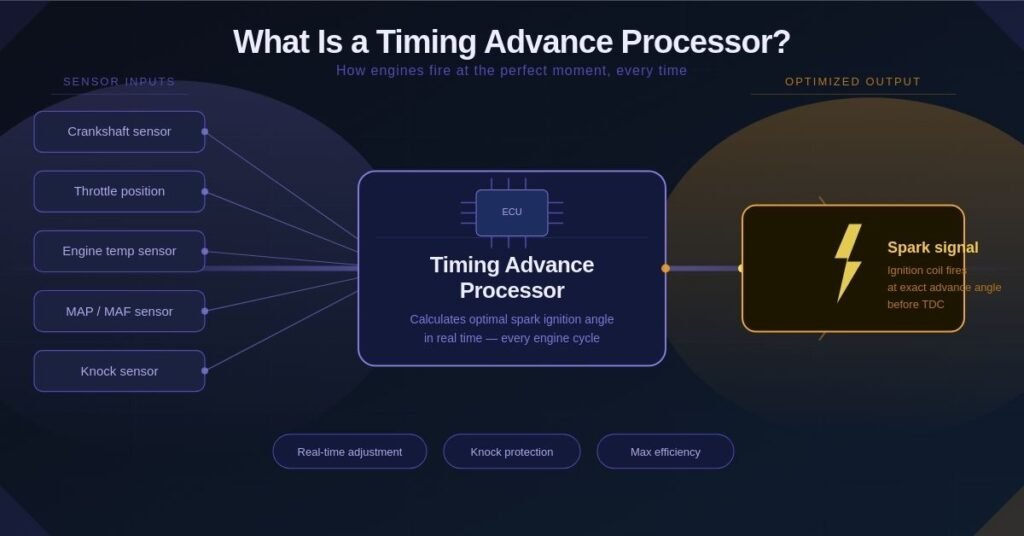
If you’ve ever wondered how your car’s engine fires at exactly the right moment — no matter the speed, temperature, or load — the answer lies in a small but critical piece of technology: the timing advance processor.
This guide explains what it is, why it matters, how it works, and why it’s become an essential topic in both automotive engineering and modern engine management systems.
What Is a Timing Advance Processor?
A timing advance processor is an electronic control unit (or module within a larger ECU) that calculates and adjusts the exact moment a spark plug fires relative to the position of the piston in the cylinder.
In simple terms: it decides when to ignite the air-fuel mixture, measured in degrees of crankshaft rotation before the piston reaches the top of its stroke (called Top Dead Center, or TDC).
Getting this timing right is critical. Fire too early and you get engine knock (a damaging detonation). Fire too late and you lose power and fuel efficiency.
Why Timing Advance Matters
The ideal ignition timing is not a fixed number. It changes constantly depending on:
- Engine RPM — higher speeds need earlier spark timing
- Engine load — heavy acceleration demands different timing than cruising
- Fuel quality — lower octane fuel is more prone to knock
- Engine temperature — a cold engine behaves differently than a warm one
- Altitude and air density — thinner air changes combustion dynamics
A timing advance processor monitors all of these variables in real time and adjusts the spark timing accordingly — sometimes hundreds of times per second.
How a Timing Advance Processor Works
Step 1: Gathering sensor data
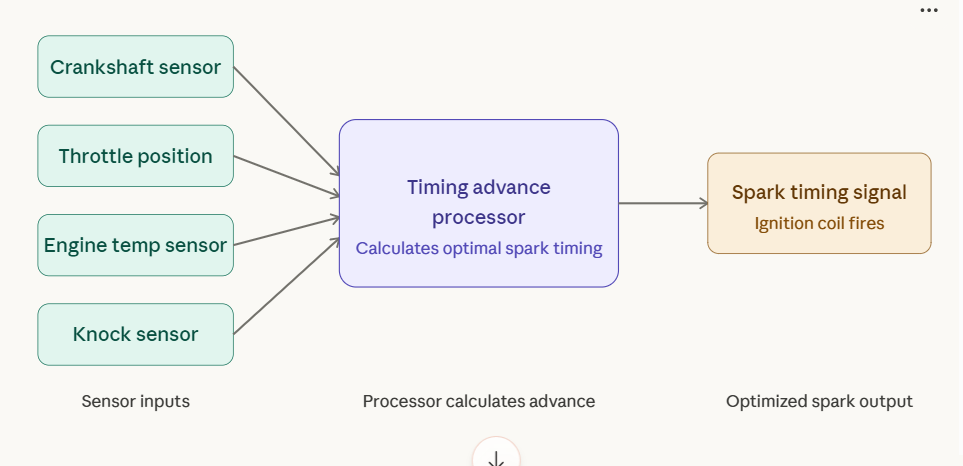
The processor receives continuous input from several sensors:
- Crankshaft position sensor — tracks piston position and engine RPM
- Throttle position sensor — measures driver demand and engine load
- Knock sensor — detects early signs of harmful detonation
- Coolant temperature sensor — monitors engine warmup state
- MAP/MAF sensor — measures air pressure or mass airflow
Step 2: Consulting the timing map
Inside the processor is a three-dimensional lookup table called a timing map (or ignition map). This is essentially a grid of ideal advance values calibrated by engineers for thousands of different operating conditions.
When the processor receives sensor data, it finds the correct cell in the map and retrieves the target advance angle — for example, “28 degrees before TDC.”
Step 3: Applying closed-loop correction
Modern processors don’t just apply the map value blindly. They use feedback, especially from the knock sensor, to make real-time corrections:
- If knock is detected, timing is retarded (delayed) immediately
- If no knock occurs over time, timing is gradually advanced back toward optimal
- This process is called knock-based closed-loop timing control
Step 4: Sending the ignition signal
Once the correct timing angle is determined, the processor triggers the ignition coil at precisely that moment. The result is a combustion event timed for maximum energy output with minimal risk of engine damage.
Types of Timing Advance Systems
Mechanical advance (older systems)
Early engines used centrifugal weights and vacuum canisters to mechanically advance timing. These were clever but limited — they couldn’t respond to knock, fuel quality, or real-time temperature.
Electronic timing advance processors
Modern vehicles use fully electronic systems integrated into the Engine Control Unit (ECU). These offer:
- Millisecond-level response times
- Multi-dimensional timing maps with hundreds of cells
- Individual cylinder timing control
- Integration with fuel injection and variable valve timing systems
Standalone timing processors
In performance and racing applications, standalone timing controllers (like those from MSD, Haltech, or Link ECU) allow tuners to build custom timing maps optimized for modified engines and specific fuel types.
Timing Advance in High-Performance Engines
In motorsport and high-performance tuning, timing advance calibration is one of the most impactful adjustments available. A skilled tuner can extract significant power gains simply by optimizing the ignition timing map.
Key considerations in performance timing calibration include:
- Maximum Brake Torque (MBT) timing — the advance angle that produces peak torque without knock
- Octane sensitivity — how much an engine benefits from higher-octane fuel
- Boost compensation — turbocharged engines require retarded timing under boost to prevent knock
- Rev-limiter interaction — timing cuts are often used as soft rev limiters
Common Timing Advance Faults and What They Mean
When a timing advance processor malfunctions or is miscalibrated, the symptoms are noticeable:
| Symptom | Likely Cause |
|---|---|
| Engine knock or pinging | Timing too advanced, or knock sensor failure |
| Poor fuel economy | Timing too retarded |
| Loss of power | Incorrect advance under load |
| Rough idle | Erratic timing signal |
| Check engine light | Sensor input fault affecting timing calculation |
Timing Advance Processors and Modern AI Engine Management
Today’s timing advance systems are increasingly sophisticated. Some manufacturers now use predictive timing algorithms that anticipate load changes before they happen, based on driver behavior patterns and real-time road data.
Electric vehicles don’t use spark timing, but the concept carries over into power electronics — where processor-controlled switching timing is equally critical for efficiency and motor performance.
Conclusion
A timing advance processor is one of the most important components in any internal combustion engine management system. It sits at the intersection of precision electronics and real-world physics — constantly calculating the ideal spark moment to balance power, efficiency, and engine protection.
Whether you’re a mechanical engineer, an automotive tuner, or simply someone trying to understand what their car’s ECU is doing, understanding timing advance is foundational knowledge. Modern engines owe much of their performance and reliability to these processors making thousands of micro-adjustments every minute — invisibly, reliably, and exactly on time.

George is a digital growth strategist and the driving force behind Business Ranker, a platform dedicated to helping businesses improve their online visibility and search engine rankings. With a strong understanding of SEO, content strategy, and data-driven marketing, George works closely with brands to turn traffic into real, measurable growth.