
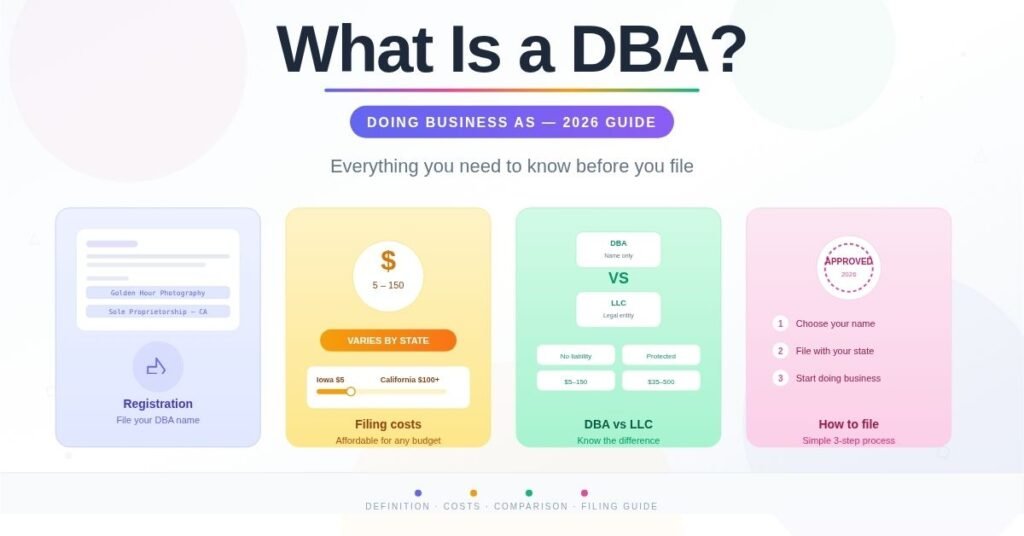
You started a business. Maybe you’re freelancing, launching a side hustle, or finally turning that idea into something real. Then someone — an accountant, a bank, a Reddit thread — tells you that you need a DBA. And now you’re here, wondering what that even means and whether it actually matters.
Short answer: a DBA stands for “doing business as.” It’s a registration that lets you operate your business under a name that’s different from your legal name. That’s it. No new legal entity. No corporate structure. Just a formal way of saying, “Hey, this business name belongs to this person or company.”
But the details matter — a lot. Who actually needs a DBA, what it costs, what it doesn’t do, and whether you’d be better off forming an LLC instead are all questions that trip people up. This guide covers all of it: the definition, the filing process, costs by state, common mistakes, and how to decide if a DBA is the right move for your situation.
What Does DBA Stand For?
DBA stands for “doing business as.” It’s also called a fictitious business name, trade name, or assumed name, depending on which state you’re in. These terms all mean the same thing.
Here’s the core idea: every business has a legal name. If you’re a sole proprietor, your legal business name is your personal name — your actual, on-your-driver’s-license name. If you formed an LLC or corporation, your legal name is whatever you put on your formation documents.
A DBA lets you use a different name for business purposes without changing your legal identity or creating a new business entity.
A Quick Example
Say your name is Maria Torres, and you start a photography business. Without a DBA, your business name is legally “Maria Torres.” Your invoices say Maria Torres. Your checks come from Maria Torres. That’s fine — but it doesn’t exactly scream “professional photography studio.”
With a DBA, Maria can register the name “Golden Hour Photography” and operate under that name instead. She can accept payments, sign contracts, and market herself under Golden Hour Photography, all while remaining a sole proprietor.
The same logic applies to LLCs and corporations. If “Torres Creative Services, LLC” wants to launch a wedding photography brand called “Golden Hour Weddings,” they’d file a DBA for that name rather than creating a whole new LLC.
Who Needs a DBA?
Not every business needs one. Whether you need a DBA depends on your business structure and what name you want to operate under.
Sole Proprietors and Partnerships
This is where DBAs come up most often. If you’re a sole proprietor or general partner and you want to use any name other than your full legal name, most states require you to file a DBA. There’s no way around it.
- “Maria Torres” → No DBA needed (it’s her legal name).
- “Maria Torres Photography” → Depends on the state. Some allow adding a descriptor; others require a DBA.
- “Golden Hour Photography” → DBA required in virtually every state.
LLCs and Corporations
If your LLC or corporation wants to operate under a name that differs from its registered legal name — even slightly — you’ll typically need a DBA. Rearranging words, dropping “LLC” or “Inc.” from your public-facing name, or launching a second brand all trigger the requirement.
Example: “Desert Tacos, Inc.” wants to go by “Desert Tacos” in its marketing. That’s technically a different name. DBA required.
Franchisees
If you buy a franchise, you might operate a corporation under your own name but need a DBA to use the franchise’s brand name legally.
Businesses Expanding to New States
If you’re operating in a new state and discover your business name conflicts with an existing company there, a DBA lets you trade under an alternate name in that market without restructuring your entire business.
What a DBA Does — and What It Doesn’t Do
This is where the misunderstanding gets expensive. People file a DBA thinking it gives them more than it actually does. Let’s be clear.
What a DBA Does
- Lets you operate under a different name than your legal or personal name.
- Creates a public record linking your business name to the actual owner. This is the original purpose — consumer protection.
- Enables you to open a business bank account under your trade name (most banks require a DBA certificate).
- Adds credibility. “Sunrise Bakery” sounds more professional than billing clients under “Jennifer Adams.”
- Allows you to accept payments made out to the business name.
What a DBA Does Not Do
- Does not create a legal entity. A DBA is not an LLC, corporation, or partnership. You’re the same entity you were before filing.
- Does not provide liability protection. Your personal assets are still on the line if something goes wrong.
- Does not give you exclusive rights to the name. Someone else in your state (or another state) can potentially use the same name. For exclusivity, you need a trademark.
- Does not replace a business license. You still need whatever licenses and permits your city, county, or state requires.
- Does not hide your identity. Public records connect the DBA to the owner. That’s literally the point.
DBA vs. LLC: What’s the Difference?
This is the comparison most people are actually trying to make when they search for “what is a DBA.” Here’s a side-by-side breakdown:
| Feature | DBA | LLC |
|---|---|---|
| Creates a legal entity? | No | Yes |
| Liability protection? | None | Yes — separates personal and business assets |
| Cost to file | $5–$150 (varies by state) | $35–$500 (varies by state) |
| Ongoing costs | Renewal every 1–10 years; usually under $50 | Annual reports, franchise taxes in some states |
| Tax implications | None — taxed as your existing structure | Pass-through by default; can elect S-Corp or C-Corp taxation |
| Name exclusivity | No | Yes, within the state of formation |
| Can open a bank account? | Yes, with DBA certificate | Yes |
| Time to set up | Days | Days to weeks |
The bottom line: A DBA is a name. An LLC is a business structure. You can have both — and many business owners do. A common setup is to form an LLC for liability protection and then file a DBA to operate under a more marketable brand name.
How to File a DBA: Step by Step
The process varies by state, but the general steps are consistent across most jurisdictions.
Step 1: Choose your business name. Pick something memorable and relevant. Check your state’s business name database and the U.S. Patent and Trademark Office (USPTO) to make sure it’s available. Avoid names that include “LLC,” “Inc.,” or “Corp.” unless your business is actually structured that way — this is illegal in most states.
Step 2: Determine where to file. Some states handle DBA filings at the state level (through the Secretary of State). Others require you to file with your county clerk. A handful require both. Check your specific state’s requirements.
Step 3: Complete and submit your application. Fill out the required form — usually straightforward, asking for your legal name, the DBA name, your business address, and the type of business.
Step 4: Publish a notice (if required). Some states — California, New York, Illinois, and others — require you to publish your DBA filing in a local newspaper for a set period of time. This can cost $50–$150 on top of filing fees.
Step 5: Receive your DBA certificate. Once approved, you’ll get a certificate or confirmation that you can use to open bank accounts and conduct business under the new name.
Step 6: Renew on schedule. DBAs aren’t permanent. Renewal periods range from every year to every 10 years depending on the state.
How Much Does a DBA Cost?
DBA filing fees are generally low — one of the cheapest business filings you’ll ever make. But the total cost depends on your state, county, and whether additional steps like newspaper publication are required.
Cost Ranges by State (Selected Examples)
| State | Filing Fee | Filed With | Notes |
|---|---|---|---|
| Arizona | $10 | Secretary of State | One of the cheapest |
| California | $10–$100 | County Clerk | Varies by county; publication required |
| Colorado | $20 | Secretary of State | Renewal every 5 years |
| Florida | $50 | Department of State | — |
| Illinois | $30–$150 | County Clerk | Fee depends on the calendar year |
| Iowa | $5 | Secretary of State | Cheapest in the nation |
| Louisiana | $75 | Secretary of State | Newspaper publication required |
| New York | Varies | County Clerk | Publication required; can be expensive in NYC |
| Pennsylvania | $70 | County level | One-time fee |
| Texas | $25 (state) / ~$20–$25 (county) | Secretary of State or County Clerk | Depends on business structure |
Hidden Costs to Watch For
- Newspaper publication fees: $50–$150 per ad in states that require them.
- Service provider fees: If you use a company like LegalZoom or ZenBusiness to handle the filing, expect to pay $100–$250 total.
- Renewal fees: Don’t forget ongoing costs. Some states charge the same filing fee again at renewal.
- Multi-county filings: If you operate in multiple counties within certain states, you may need to file (and pay) in each one.
Myths vs. Facts About DBAs
Myth: A DBA protects my business name from being used by others. Fact: It does not. A DBA registration is a notice filing, not an intellectual property protection. If you want exclusive rights to a name, you need to file for a state or federal trademark.
Myth: Filing a DBA means I’ve formed a business. Fact: A DBA does not create a business entity. It’s a name registration. If you’re a sole proprietor before filing a DBA, you’re still a sole proprietor after.
Myth: A DBA protects my personal assets from business lawsuits. Fact: Zero liability protection. If someone sues your business and you operate as a sole proprietor with a DBA, your personal bank account, house, and car are potentially at risk. Only a formal business structure like an LLC or corporation provides that shield.
Myth: I don’t need a DBA if I’m just freelancing. Fact: If you’re operating under any name other than your full legal name — even something as simple as “Smith Consulting” instead of “John Smith” — most states require a DBA.
Myth: Once I file a DBA, it lasts forever. Fact: DBAs expire. Depending on the state, you’ll need to renew every 1 to 10 years. Failure to renew can result in fines or loss of the ability to use the name.
When a DBA Makes Sense (and When It Doesn’t)
A DBA is a good fit if:
- You’re a sole proprietor or partner who wants a professional-sounding business name without the cost and complexity of forming an LLC.
- Your LLC or corporation is launching a new brand, product line, or service that doesn’t match your registered name.
- You need to open a business bank account and your bank requires a DBA certificate.
- You’re testing a business idea and want to operate under a real name without committing to full entity formation.
Skip the DBA and consider an LLC instead if:
- You need personal liability protection. A DBA will not protect your personal assets.
- You want exclusive rights to your business name within the state.
- You’re planning to take on significant debt, hire employees, or enter contracts with substantial risk.
- You want tax flexibility (LLCs can elect different tax treatments).
A Note From the Field: Common DBA Mistakes
Having worked with hundreds of small business owners navigating the registration process, a few patterns emerge again and again.
The most common mistake is treating a DBA as a substitute for proper business formation. New entrepreneurs file a DBA and assume they’re “official” — they skip the LLC, skip the EIN, and skip business insurance. Then a client dispute or liability issue hits, and they discover their personal assets are exposed.
The second mistake is ignoring renewal deadlines. A lapsed DBA can create problems you don’t see coming: banks freezing accounts, inability to enforce contracts signed under the DBA name, and fines from the state.
Third: not checking trademark databases before filing. Your state might approve a DBA name that’s already trademarked by another company nationally. The DBA filing won’t protect you from a trademark infringement claim.
The best approach for most small business owners in 2026 is to form an LLC first, then file a DBA if you need an alternate brand name. This gives you both legal protection and branding flexibility.
Frequently Asked Questions
Is a DBA the same as an LLC?
No. A DBA is a registered business name, not a legal entity. An LLC (limited liability company) is a formal business structure that provides personal liability protection and tax flexibility. You can have a DBA and an LLC — many businesses do — but they serve different purposes.
How long does it take to get a DBA?
In most states, the process takes anywhere from a few days to a few weeks. Online filings are typically faster. States that require newspaper publication add additional time — usually 4 to 6 weeks for the publication period to complete.
Can I have more than one DBA?
Yes. There’s no limit to the number of DBAs a business can register. This is common for companies that operate multiple brands under a single legal entity. Each DBA requires its own filing and fee.
Do I need a DBA to open a business bank account?
If you want to open an account under a name other than your personal legal name, most banks will require a DBA certificate as proof that you’re authorized to use that business name. Some banks also require an EIN.
Does a DBA protect my business name?
No. A DBA is a notice filing, not an intellectual property protection. Other businesses in your state — or in other states — can potentially use the same name. To protect your name, you’d need to file for a trademark with the USPTO.
What happens if I don’t file a DBA?
Consequences vary by state. Some states impose fines. Others may prevent you from enforcing contracts signed under the unregistered name. In some jurisdictions, you could be denied access to the court system for business disputes until you register.
What Comes Next
A DBA is one of the simplest filings in the business world, but it’s also one of the most misunderstood. It’s not a business structure. It’s not liability protection. It’s not a trademark. It’s a name — registered, public, and useful for building a brand without the overhead of a new entity.
If you’re just starting out and want to test a business idea under a professional name, a DBA is a fast, cheap way to get moving. If you’re an established LLC or corporation branching into new territory, a DBA lets you do that without the paperwork of forming another entity.
But if liability protection is on your radar — and it should be — don’t stop at the DBA. Consider pairing it with an LLC, getting proper insurance, and consulting with an attorney or accountant who understands your specific state’s requirements.
Your next steps:
- Check your state’s DBA requirements and fees (your Secretary of State’s website is the best starting point).
- Search your state’s business name database to confirm availability.
- Decide whether you need an LLC in addition to (or instead of) a DBA.
- File your DBA — or consult a business attorney if your situation is complex.
CLICK HERE FOR MORE BLOG POSTS

George is a digital growth strategist and the driving force behind Business Ranker, a platform dedicated to helping businesses improve their online visibility and search engine rankings. With a strong understanding of SEO, content strategy, and data-driven marketing, George works closely with brands to turn traffic into real, measurable growth.