
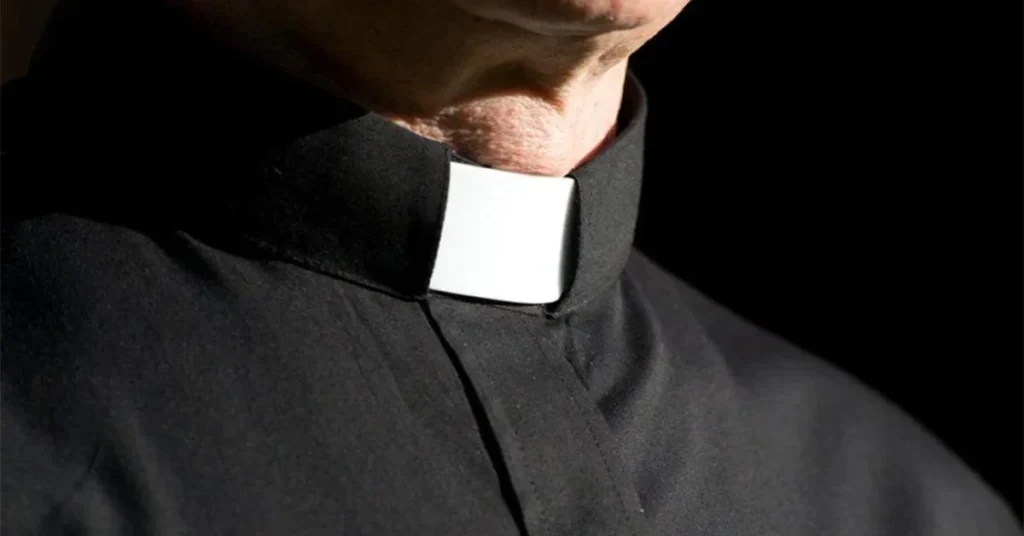
Ever notice how a single detail can stop you mid-thought? A priest collar does exactly that. It’s just a thin strip of white against black, but it carries centuries of history, theology, and even fashion debate. Whether you’ve seen it in your local parish, in a movie, or during a wedding, the priest collar has a way of making you pause.
So what’s really behind the priest collar? Why do clergy wear it, where did it come from, and how has its style changed over time? Let’s pull back the curtain. We’ll walk through the surprising origins of the priest collar, what it symbolizes today, the different styles you’ll see around the world, and why it still matters in 2026. By the end, you’ll see that little white band in a whole new light.
ALSO READ: Before Adam: Did God Create Dinosaurs And Why It Matters
What Is A Priest Collar? A Quick Definition Before We Dive In
At its simplest, the priest collar is a stiff band of white fabric worn around the neck by Christian clergy. Most people know it as the “clerical collar” or “Roman collar.” Today, it’s usually paired with a black shirt or cassock, creating that instantly recognizable black-and-white look.
But calling it just a dress code misses the point. The priest collar acts like a uniform, a symbol, and a conversation starter all at once. For clergy, putting it on is often described as “putting on” their role. For the public, it signals someone who’s available for prayer, counsel, or help.
There are two main types you’ll spot: the tab collar, which is a small white square tucked into a black shirt, and the full band collar, which wraps all the way around the neck. We’ll break those down more later.
The History Of The Priest Collar: It Didn’t Start In Church
Here’s the twist: the priest collar didn’t begin as a religious invention. Its roots are actually in 16th and 17th-century fashion.
From Ruffled Collars to Clerical Identity
In the 1500s, European noblemen wore large, stiff, detachable collars called “bands.” They were status symbols — hard to wash, hard to wear, and very visible. Think Shakespearean portraits. Over time, Protestant ministers in England began adopting a simplified version of these bands. Why? To look professional and set apart from laypeople, but without the extravagant lace of the aristocracy.
The Roman Catholic Church was slower to adopt it. For centuries, priests wore cassocks without any special collar. The shift happened in the 19th century when Rev. Donald McLeod, a Scottish Presbyterian minister, popularized the detachable clerical collar around the 1860s. It was practical: easy to remove and wash during a time when laundry wasn’t simple.
Why the Catholic Church Embraced It
By 1884, the Third Plenary Council of Baltimore in the U.S. recommended Catholic clergy wear the Roman collar to distinguish themselves in public. It solved a real problem. In growing cities, priests needed to be identifiable while ministering in hospitals, prisons, and on the streets. The collar became a quiet badge of service.
So, the priest collar started as fashion, became Protestant practice, and then turned into a global Catholic and Anglican norm. Not what most people expect.
The Symbolism Behind The Priest Collar: More Than Fabric
Ask ten priests what the collar means and you might get ten different answers. But a few themes come up again and again.
A Sign of Surrender and Service
The circle of the full collar represents many things: the unbroken line of Christ’s love, eternity, and a priest’s vow of obedience. Putting it on each morning is, for many clergy, a private act of dedication. It’s a reminder that they’re “on duty” for their community. The white stands for purity and the hope of resurrection, while the black represents humility and dying to oneself.
Visibility in a Distracted World
In a world of endless scrolling and noise, the priest collar cuts through. It tells people, “I’m here if you need to talk about faith, grief, or hope.” Hospital chaplains share stories of patients flagging them down just because of the collar. It’s not about power; it’s about availability.
Unity Across Denominations
Roman Catholics, Anglicans, Lutherans, Methodists, and some Orthodox priests all use versions of the priest collar. While theology differs, the collar has become a shared visual language. It bridges traditions in a way few other symbols do.
Priest Collar Styles: Tab, Full Band, And Modern Takes
Not all collars are created equal. If you’ve ever wondered why some look like a white choker and others are just a small tab, here’s the breakdown.
The Full Band Collar or Roman Collar
This is the classic. A white plastic or cotton band that wraps fully around the neck, worn with a collarless shirt or cassock. It’s most common among Catholic priests. The look is formal, traditional, and leaves no question about the wearer’s role.
Pros: Very recognizable, traditional.
Cons: Can be hot in summer and stiff for long days.
The Tab Collar or Clergy Shirt Collar
Popular with Anglicans, Lutherans, and many Catholic priests in the U.S., this style uses a black shirt with a small slot at the throat. A white plastic tab slides in, showing just a small white square. It’s cooler, easier to wear, and looks like a normal dress shirt from a distance.
Pros: Comfortable, modern, easy to launder.
Cons: Less visible from far away.
Cassock and Rabat Styles
In more traditional or formal settings, priests wear a cassock — a long black robe — with a detachable white collar. In some Orthodox and Anglican traditions, you’ll see a “rabat,” a wider bib-like white cloth. These styles lean ceremonial and are common for liturgies.
Modern Adaptations: Color, Material, and Women Clergy
Here’s where it gets interesting. The priest collar has evolved:
- Colored shirts: While black is standard, you’ll see blue, gray, or khaki clergy shirts, especially in chaplaincy or tropical climates. The white collar remains.
- Women clergy: As more denominations ordain women, designers have adapted the collar for women’s shirts — better fits, softer materials, and sizes that work with different necklines.
- Materials: Plastic tabs are still common, but washable cotton, silicone, and flexible bands are gaining ground for comfort.
Style still respects tradition, but function matters. A hospital chaplain doing 12-hour shifts needs something different than a cathedral rector.
Wearing The Priest Collar Today: Rules, Choices, And Real Life
So who has to wear it, and when? The rules aren’t one-size-fits-all.
Denominational Expectations
- Roman Catholic: Canon law doesn’t mandate the collar, but local bishops usually do. Most diocesan priests wear it daily in public. Religious orders might have different norms.
- Anglican/Episcopal: Strongly encouraged, especially for public ministry, but not always required.
- Lutheran/Methodist: Common but often optional. Many pastors wear it on Sundays or during pastoral visits.
- Orthodox: Traditionally wear cassocks and often a different style of collar or no visible collar, depending on jurisdiction.
When Clergy Take It Off
Yes, priests go “off-duty.” Many don’t wear the collar while on vacation, doing yard work, or in situations where it might create a barrier. Others wear it constantly as a witness. There’s no universal rule — it’s about prudence and mission.
The Collar in Public: Stories From the Field
Ask any priest and they’ll have collar stories. Being asked for prayer in an airport. Getting a free coffee from a stranger. Or, on the flip side, being challenged about the Church. The priest collar invites conversation, both warm and hard. It makes ministry possible in line at the grocery store.
How To Care For A Priest Collar: Practical Tips For Clergy
If you’re a new seminarian or just curious, here’s what keeps a collar looking sharp:
Plastic tabs: Buy in bulk. They crack and discolor. Rinse them, don’t scrub, to avoid scratches.
Cotton bands: Hand wash or gentle cycle. Starch lightly if you want that crisp look.
Shirts: Clergy shirts are designed with higher collars. Regular dress shirts won’t fit a tab collar. Invest in 3–5 good ones.
Heat hack: In hot climates, many priests switch to tab collars and lightweight microfiber shirts. Comfort keeps you present for ministry.
The Priest Collar And Fashion: From Sacred To Streetwear
Culture has borrowed the collar too. Fashion designers like Jean-Paul Gaultier and Givenchy have put clerical collars on runways. TV shows like Fleabag and The Young Pope turned the collar into a pop culture icon — symbolizing tension, desire, and authority.
That crossover says something: the priest collar has visual power. It communicates instantly. For the Church, that’s a reminder that symbols matter. For the rest of us, it explains why we can’t help but notice it.
Conclusion
Behind the priest collar is a story of fashion, faith, and function. It started as a 17th-century style trend, became a practical tool for ministry in the 1800s, and now serves as a global symbol of spiritual availability.
The style may change — from stiff Roman bands to breathable tab shirts — but the core symbolism holds: service, visibility, and a life set apart for others. Next time you see that flash of white, you’ll know it’s not just a dress code. It’s 400 years of history resting on someone’s shoulders.
Whether you’re clergy, curious, or just love the stories behind what we wear, the priest collar proves that even the smallest details can carry the deepest meaning.
FAQs
What is a priest collar called?
The priest collar is most commonly called a “clerical collar” or “Roman collar.” The version with a small white square is called a “tab collar,” while the full circle style is the “full band” or “Roman collar.”
Can any Christian minister wear a priest collar?
Yes, but it depends on denomination. Catholic, Anglican, Lutheran, Methodist, and some other traditions use it. Many evangelical or non-denominational pastors don’t wear collars as part of their tradition.
Why is the priest collar usually black and white?
Black symbolizes humility, sacrifice, and dying to self. White represents purity, light, and resurrection hope. Together, they visually express the priest’s role and vows.
Do priests sleep in their collar?
No. The collar is for public ministry and liturgical functions. Priests remove it at home, just like any work uniform, unless they’re “on call” for emergencies.
Is it disrespectful for a non-priest to wear a collar for a costume?
Context matters. Wearing it for a play or film is generally fine. Wearing it to impersonate clergy or gain trust dishonestly is considered disrespectful and, in some places, illegal.
ALSO READ: Heartbeat Lines: Poems For Slam Poetry

Prose is a content specialist and contributing writer at Business Ranker, where he covers the intersection of SEO, digital marketing, and emerging technology. With a sharp eye for detail and a passion for making complex topics accessible, Prose brings a research-driven approach to every piece he writes. His work spans local search optimization, AI in business, content strategy, and web performance — always grounded in real-world application rather than theory. Prose believes in writing that earns trust through depth, accuracy, and clarity, which is why every article he publishes is backed by thorough research, credible sources, and hands-on insight. When he’s not breaking down the latest algorithm updates or exploring how businesses can leverage new tools for growth, Prose is diving into data, testing strategies, and staying ahead of the digital curve to deliver content readers can genuinely rely on.